The 5 Components of Modern Patient Engagement Platform


Listen to the article
Prefer listening over reading? Press play to hear the full article.
Patient engagement can look deceptively simple from the outside.
A patient receives a text reminding them to schedule a screening. Someone calls after a hospital discharge. A care manager notices that a member hasn't completed an annual health assessment and follows up. The interaction itself might take a few minutes.
Making that interaction happen at the right time, for the right patient, with the right information available to the care team is considerably more complicated. Behind effective patient engagement sits an ecosystem of software, healthcare data, operational workflows, and people.
A platform may need to know whether a patient was recently discharged from the hospital, verify their insurance eligibility, identify any outstanding care gaps, determine which intervention is appropriate, assign outreach to the right person, and ultimately understand whether that intervention resulted in the patient receiving care.
This distinction becomes particularly important as healthcare organizations grow. You can manage hundreds of patients with relatively simple tools and manual processes. You cannot manage hundreds of thousands the same way.
At that point, patient engagement becomes infrastructure. So what does that infrastructure actually need to look like?
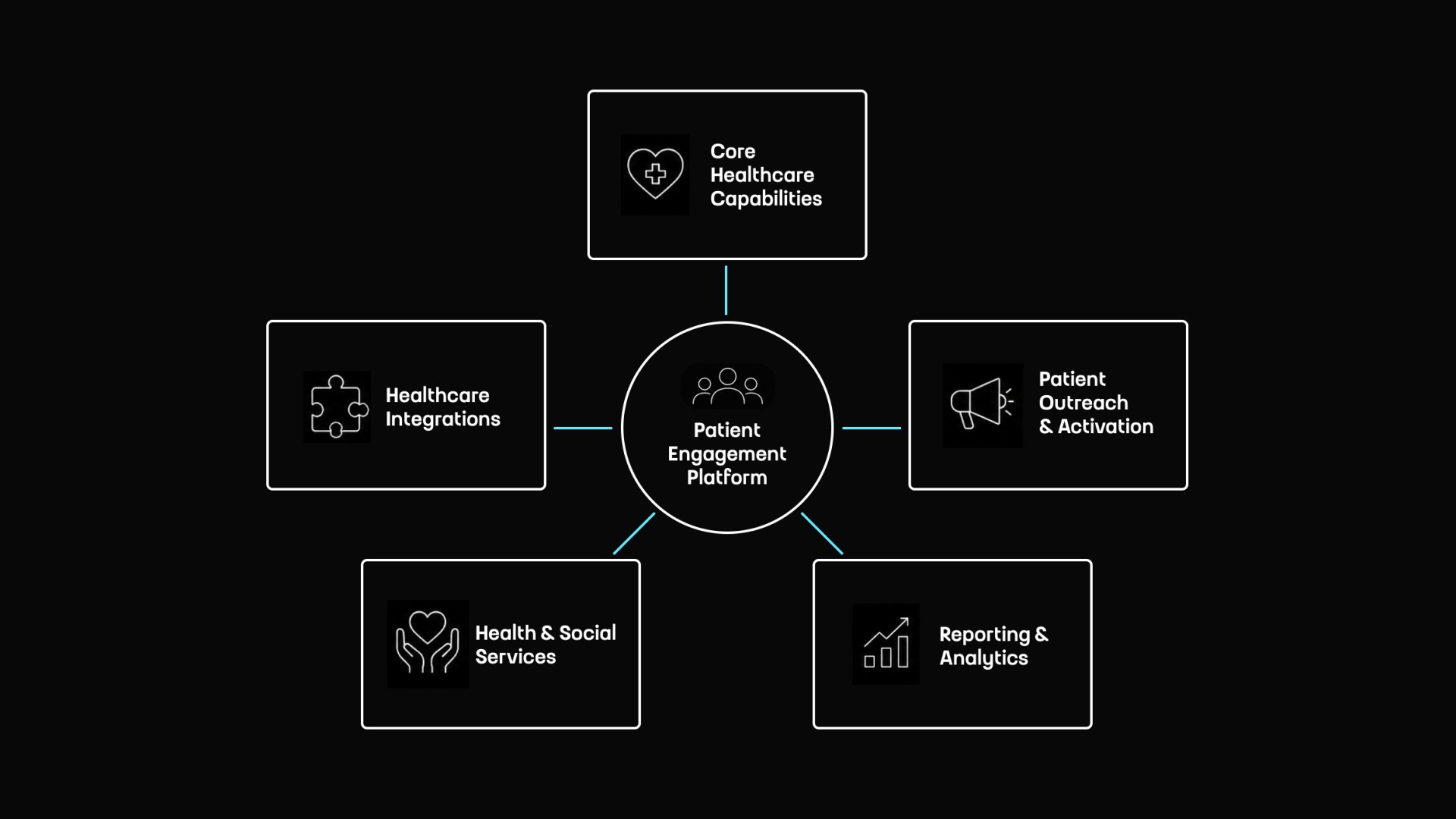
Based on our experience developing healthcare technology and a recent conversation with Charles Oyibo from BigHeart, we can break a modern patient engagement platform into five interconnected components:
- Core healthcare and engagement capabilities
- Healthcare data and system integrations
- Outreach and patient activation
- Integrated health and social care services
- Reporting and analytics
None of these components is particularly powerful in isolation. Together, they create the infrastructure required to move from simply communicating with patients to actually coordinating their healthcare journey.
About This Article
This article is based on a conversation between Touch4IT and Charles Oyibo, Principal at BigHeart, a U.S. healthcare organization that uses technology and community-based engagement to support large Medicaid populations.
Touch4IT has worked alongside BigHeart for more than six years, helping develop and evolve the technology behind its healthcare operations.
During our conversation, Charles described BigHeart through five capabilities that together differentiate its approach: core platform modules, integrations with external healthcare systems, an outreach and engagement model, integrated health and social services, and reporting and analytics. We've used that framework as the starting point for this article.
Rather than presenting BigHeart's architecture as a blueprint that every healthcare organization should copy, we'll use the five components to examine a broader question:
What capabilities does a modern patient engagement platform actually need once it moves beyond basic messaging and patient portals?
🎙️ Listen to the full conversation with Charles Oyibo here.
1. Core Healthcare and Engagement Capabilities
The first part is the platform itself. Patient engagement software needs somewhere for healthcare interactions to actually happen.
In BigHeart's case, Charles described a collection of modules built around engagement rather than a single patient-facing application. One of those concepts is communities.
Patients can be organized into groups with shared characteristics or needs, creating a structure through which engagement can be coordinated. But engagement doesn't stop there.
The platform also supports digital education and training programs, virtual interactions, and an Electronic Health Record to facilitate the delivery of telehealth services, including medical and mental healthcare.
This illustrates an important architectural principle.
A mature patient engagement platform shouldn't exist as an isolated communication system sitting beside the healthcare journey.
It needs to connect engagement with the actual delivery of care.
A patient might begin by receiving outreach about an unmet healthcare need. They could then complete an assessment, participate in a digital health program, speak with a healthcare professional virtually, and continue receiving follow-up support. From the patient's perspective, these may feel like separate interactions. From the platform's perspective, they should form one continuous journey.
That is where patient engagement platforms begin to differ substantially from basic patient portals and messaging tools.
The goal is to create a digital infrastructure through which healthcare organizations can engage patients and coordinate next steps.
2. Healthcare Data and System Integrations
The second component is less visible, but arguably more important.
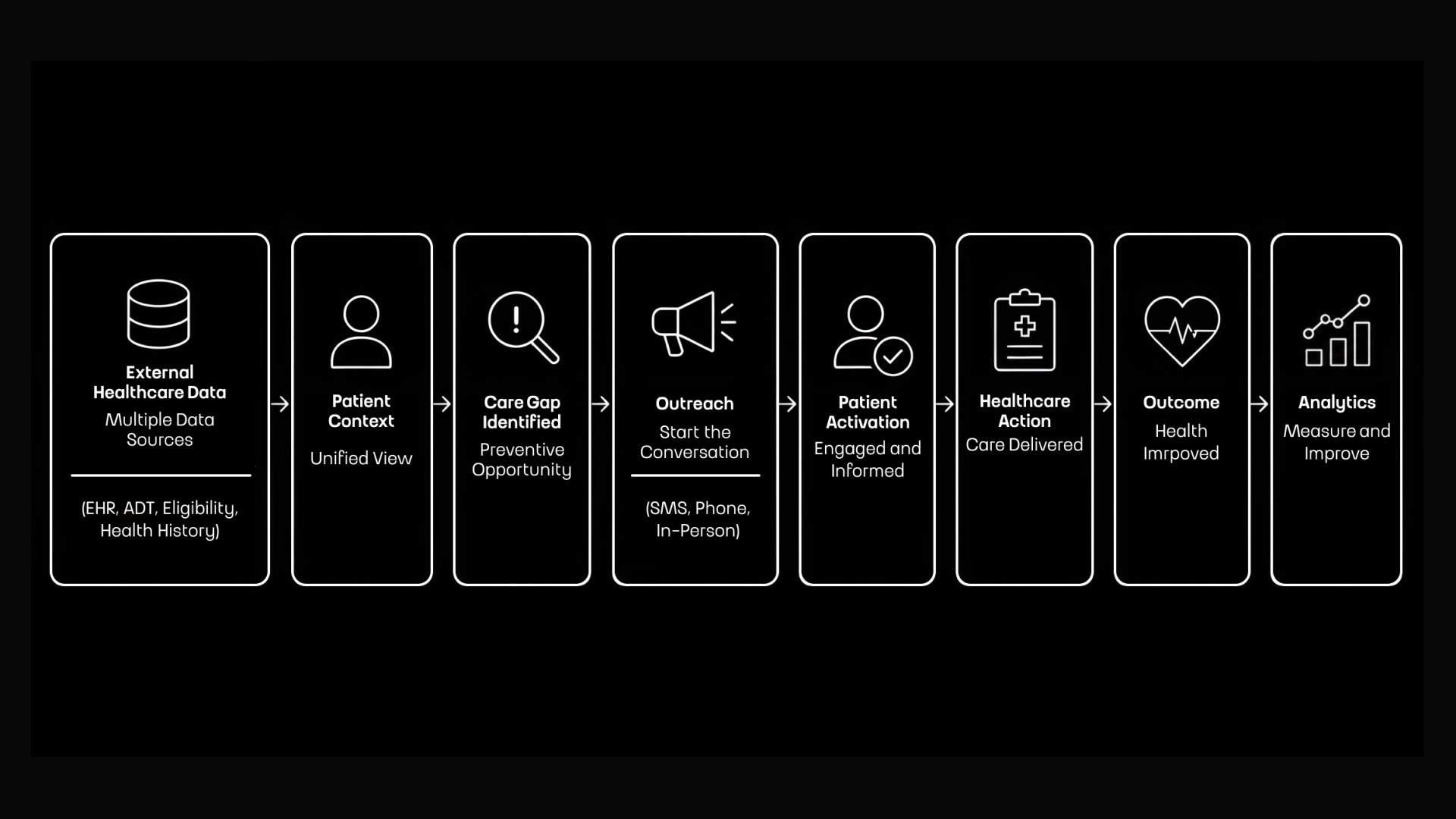
A patient engagement platform needs to know what is happening to the patient outside the platform. Charles gave a useful example during our conversation: admissions, discharge, and transfer data, commonly referred to as ADT.
Imagine that a Medicaid member visits an emergency department.
The engagement platform needs to know that this happened if the organization wants to intervene after discharge. An ADT integration can provide information about patient movement between healthcare settings, allowing the platform and care teams to respond to events occurring elsewhere in the healthcare system. That might trigger a transition-of-care workflow. But hospital movement is only one part of the picture.
Charles also described integrations supporting:
- insurance eligibility,
- patient health history,
- diagnoses,
- and existing care gaps.
Each data source answers a different operational question.
Is this patient currently eligible for the service? What happened to them recently? What conditions are they managing? What recommended healthcare activities haven't been completed?
Without those answers, personalization becomes guesswork. This is why interoperability becomes increasingly important as patient engagement platforms mature. The visible engagement might still be something as simple as a phone call.
But the intelligence determining who receives that call and why may depend on information flowing across several independent healthcare systems. This is also where the engineering complexity increases dramatically.
Integrating healthcare systems means dealing with different data structures, different vendors, changing records, security requirements, and workflows that may have evolved independently for years.
The challenge isn't simply connecting API A to API B. It's transforming fragmented healthcare information into something that can reliably trigger an operational action. And that's what ultimately makes interoperability valuable. The outcome is the intervention.
3. Outreach and Patient Activation
Having the right data doesn't mean much if nothing happens with it.
This is the third component of a modern patient engagement platform: turning information into action.
And there is an important distinction here. Outreach is not the same as engagement.
A healthcare organization can send thousands of text messages without meaningfully engaging a single patient. Engagement happens when outreach results in action.
A patient completes their annual health assessment. They schedule an overdue doctor's visit. They attend a preventive screening. They start monitoring their blood pressure. They participate in a health program. Or they reconnect with a care team after previously falling out of the healthcare journey. This is why Charles describes BigHeart not simply as a healthcare platform, but as an "engine that powers engagement."
The technology helps identify people who need attention. The engagement model determines how to reach them and move them toward the next appropriate action. In practice, that requires more than one communication channel.
In the Illinois Medicaid program Charles discussed, outreach can happen through SMS, phone calls, and even in person. That last channel is particularly important.
Some patients are inherently difficult to reach digitally. Phone numbers change. Messages go unanswered. Digital literacy varies. Other barriers in a patient's life may simply be more urgent than responding to a healthcare notification. In those cases, engagement may require a human being.
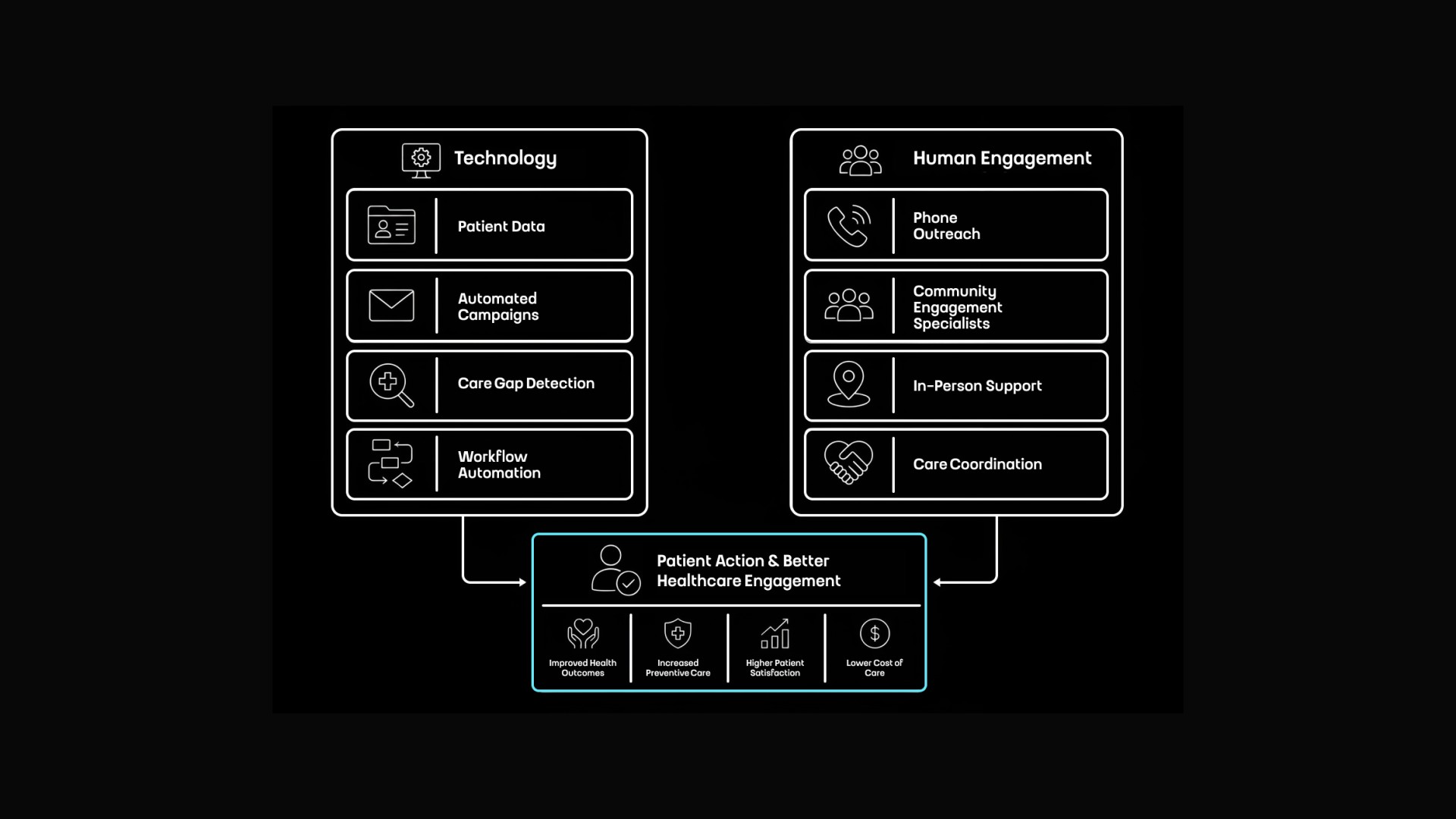
BigHeart uses Community Engagement Specialists alongside automated outreach campaigns to help reach these populations and guide them toward appropriate healthcare activities. The technology and the human engagement model therefore aren't competing approaches. They complement each other.
Software can help determine who needs attention, why they need it, and what should happen next.
People can provide the trust, persistence, and empathy required to make that action happen.
For healthcare organizations designing patient engagement platforms, this has an important implication: Don't design the platform around communication channels. Design it around patient actions.
SMS, phone calls, mobile applications, and in-person outreach are simply different mechanisms for reaching the same goal. The real measure of engagement is what happens next.
4. Connecting Healthcare With Social Services
The fourth component extends patient engagement beyond healthcare itself.
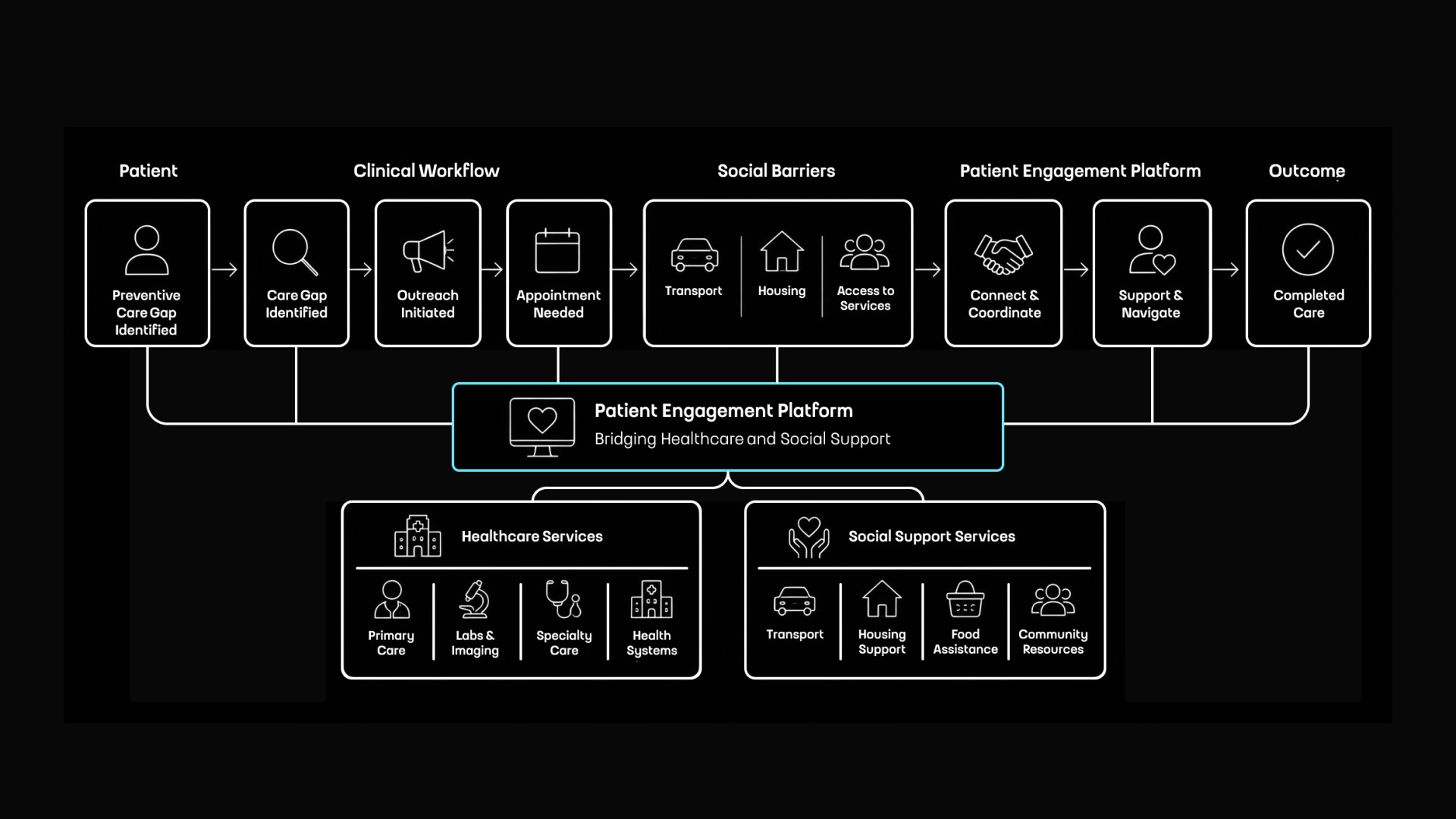
A patient's health isn't determined exclusively by what happens in a doctor's office. Transportation matters. Housing matters. Access to food and other essential services matters. A patient may understand perfectly well that they need to attend an appointment and still have no reliable way of getting there.
These factors are commonly described as social determinants of health and pose an important challenge for digital health platforms. You can identify the correct clinical intervention and still fail to improve the patient's outcome because the barrier preventing action isn't clinical at all.
Charles described this as another important part of BigHeart's model: healthcare services can be integrated with social services to address factors strongly associated with health outcomes.
Consider a simple example. A platform identifies that a patient is overdue for a preventive examination. The patient receives outreach. They respond. An appointment is available. From a traditional patient engagement perspective, the workflow appears successful. But the patient has no transportation. If the system stops at the appointment scheduling step, the underlying care gap may remain open. A more comprehensive model asks another question:
What is preventing this patient from completing the recommended action?
That changes how patient engagement platforms need to be designed. Instead of viewing patients exclusively through clinical data, healthcare organizations increasingly need workflows that incorporate social needs and connect patients with appropriate support.
This is particularly relevant when working with populations where healthcare challenges frequently overlap with economic and social barriers. It also demonstrates why patient engagement is difficult to reduce to a single product category.
At sufficient scale, it intersects with care management, population health, community services, and healthcare delivery itself.
5. Reporting and Analytics
The first four components help healthcare organizations act. The fifth helps them understand whether those actions are working.
Charles described reporting and analytics as the capability that allows organizations to gain insights and use them to improve future offerings. That distinction matters. Healthcare dashboards are easy to build. Useful healthcare analytics are considerably harder.
A patient engagement platform shouldn't simply report how many messages were sent or how many patients logged into an application. Those are activity metrics. The more important questions are closer to the healthcare outcome:
How many patients were successfully reached? How many completed the intended action? Which outreach channels were most effective? Which care gaps were successfully closed? Which patient populations remain difficult to engage? Where are patients dropping out of the workflow?
Over time, these insights can change how engagement itself operates.
Perhaps one population responds particularly well to SMS while another consistently requires telephone outreach. Perhaps patients are responding to outreach but failing to complete referrals. Perhaps a particular workflow creates unnecessary friction for care teams. Analytics allows healthcare organizations to move from simply operating patient engagement programs to continuously improving them.
This creates a feedback loop:
Data → Intervention → Patient Action → Outcome → Insight → Better Intervention
The platform becomes a system for learning from workflows.
Why the Five Components Need to Work Together
The real value of these five components becomes clearer when we stop looking at them individually.
Consider a patient who hasn't completed a recommended preventive screening. First, the platform needs the core healthcare capabilities required to manage the patient's journey. Then it needs external healthcare data to recognize that the screening represents an open care gap.
The outreach and engagement determine how to reach the patient and encourage them to act. If transportation or another non-clinical barrier prevents the patient from attending, integrated social services may be incorporated into the workflow.
Finally, reporting and analytics determine whether the intervention succeeded and help the organization improve similar interventions in the future. None of these capabilities solves the problem alone. Together, they create a continuous healthcare workflow.
That is the fundamental difference between building another healthcare application and building patient engagement infrastructure.
What This Looks Like in Practice: Illinois Medicaid
The Illinois Medicaid program Charles discussed provides a useful example of how these components come together in the real world.
The State of Illinois issued a Request for Proposal for a medical platform capable of helping reach its Medicaid population.
The underlying challenge was engagement.
How do you reach people who may be difficult to contact and help them complete the healthcare activities that could improve their long-term outcomes? BigHeart was engaged to support outreach to more than half a million Medicaid recipients.
According to Charles, that outreach spans multiple channels, including SMS, phone, and in-person engagement. The objective is to help members complete activities, such as annual health screenings, and to identify gaps in their care that require additional intervention.
A patient might need a mammogram. Another might need an annual physical examination. Someone else might need to be referred to a healthcare provider. The engagement platform helps turn those unmet needs into structured workflows. And there is an economic rationale behind the model as well.
Preventive interventions can help identify health problems earlier and potentially reduce the burden associated with managing chronic disease later. For the payer, patient engagement therefore isn't simply a measure of whether members use a digital platform. It can become part of a broader strategy for improving health outcomes while managing the long-term cost of care.
From Communication Software to Healthcare Infrastructure
Looking at these five components together changes the definition of a patient engagement platform.
It's not an SMS tool. It's not a patient portal. It's not a telehealth application. And it's not simply a CRM adapted for healthcare.
At sufficient scale, a patient engagement platform becomes an operational system connecting healthcare data, patients, care teams, external services, and measurable outcomes.
The patient may only see the final interaction. A text message. A phone call. A virtual appointment. A conversation with a Community Engagement Specialist.
Behind that interaction may sit an entire chain of technology and healthcare operations working together to determine what should happen next. That's why the strongest patient engagement platforms aren't necessarily those with the longest feature lists.
They're the ones that can connect these five components into a coherent healthcare journey.
Final Thoughts
Patient engagement is easy to describe and difficult to execute.
The basic objective sounds simple: help patients participate more actively in their healthcare. But doing that consistently across large populations requires much more than communication software.
It requires a platform capable of supporting healthcare delivery. It requires integrations that provide the context necessary to make decisions. It requires an engagement model that turns outreach into action. It requires an understanding that barriers to healthcare often exist outside the healthcare system. And it requires analytics that show what is actually working.
The five-component framework Charles described during our conversation with BigHeart provides a useful way to think about that complexity:
Core platform capabilities.
Healthcare integrations.
Outreach and engagement.
Integrated health and social services.
Reporting and analytics.
The individual technologies behind those components will continue to change. The underlying challenge will remain the same:
How do you turn healthcare data and technology into actions that actually improve the patient's journey?
For healthcare organizations building patient engagement products, that's ultimately the question the architecture needs to answer.
Building a Patient Engagement Platform?
At Touch4IT, we've spent more than six years working alongside BigHeart to develop healthcare technology supporting complex patient engagement, care management, and population health workflows.
If you're building a new patient engagement product or evolving an existing platform as it becomes more complex, we'd be happy to discuss the architecture, integrations, and engineering challenges behind it.
Have questions about Patient Engagement Platforms or healthcare software development? Talk to our colleague Jan.
FAQs
What are the key components of a patient engagement platform?
A modern patient engagement platform should combine core healthcare capabilities, integrations with external healthcare systems, patient outreach and activation, connections to relevant health and social services, and reporting and analytics. These components work together to turn healthcare data into coordinated patient actions.
What features should patient engagement software include?
Important features can include patient communication, care gap identification, telehealth, digital health programs, EHR capabilities, eligibility verification, healthcare integrations, workflow automation, and analytics. The exact feature set depends on the population and healthcare workflows being supported.
Why are healthcare integrations important for patient engagement?
Patient engagement depends on context. Integrations with EHRs, eligibility systems, ADT feeds, and other healthcare data sources can help platforms understand what has happened to a patient and determine what action may be needed next.
What is patient activation?
Patient activation is the process of helping patients take meaningful actions related to their health, such as scheduling an appointment, completing a health assessment, attending a screening, or participating in a health program. It goes beyond simply contacting the patient.
How do social determinants of health affect patient engagement?
Factors such as transportation, housing, and access to social services can prevent patients from completing recommended healthcare activities, even after successful contact. Patient engagement strategies may therefore need to address both clinical and non-clinical barriers.
How should healthcare organizations measure patient engagement?
Organizations should look beyond activity metrics such as messages sent. More meaningful measures include the number of patients successfully reached, actions completed, care gaps addressed, workflow completion, and differences in engagement across populations and communication channels.