What Is a Patient Engagement Platform? Why Most Digital Health Solutions Fail Without One


Listen to the article
Prefer listening over reading? Press play to hear the full article.
This article is based on our conversation with Charles Oyibo, Principal at BigHeart, a U.S. healthcare technology company supporting Medicaid populations through patient engagement, care management, and population health solutions.
For more than six years, Touch4IT has worked alongside the BigHeart team, helping build and evolve a platform that supports hundreds of thousands of Medicaid beneficiaries. During our discussion, we explored what patient engagement looks like in practice, why many digital health initiatives struggle to maintain long-term participation, and the engineering challenges behind building engagement platforms at scale.
Rather than simply summarizing our conversation, this article combines Charles's insights with our own experience delivering healthcare software to explain what makes a modern patient engagement platform successful.
🎙️ Listen to the full conversation with Charles Oyibo here.
Healthcare has an engagement problem.
Over the past decade, healthcare organizations have invested billions of dollars in digital transformation. Hospitals introduced patient portals. Insurers launched mobile apps. Startups built remote patient monitoring platforms, AI assistants, digital therapeutics, and virtual care solutions.
The technology has never been better. Yet many of these initiatives struggle to achieve meaningful clinical or financial outcomes.
Not because the software doesn't work. Because patients never become part of the process.
Annual wellness visits remain incomplete. Preventive screenings are missed. Remote monitoring devices end up in drawers after a few weeks. Care managers spend hours trying to contact patients who never answer the phone.
The technology functions exactly as designed. The patient journey doesn't.
This is a challenge we have repeatedly seen while working on digital health platforms in the United States. One lesson became clear very quickly. Building healthcare software is often the easier part. The real challenge is designing systems that encourage patients to consistently participate in their own care.
That challenge is exactly what patient engagement platforms are built to solve.
What Is a Patient Engagement Platform?
A patient engagement platform is a software platform that helps healthcare organizations actively involve patients in their healthcare journey.
That definition sounds straightforward. The reality is considerably more complex.
Healthcare organizations already have countless systems capable of storing information. Electronic Health Records manage clinical documentation. Patient portals provide access to medical records. Scheduling systems book appointments. Remote monitoring platforms collect biometric data.
None of those systems guarantee that patients will actually take action. A patient engagement platform focuses on something different.
Instead of asking: "Where should we store patient information?", it asks: "How do we help this patient complete the next important step in their care?"
That next step might be:
- completing an annual wellness visit
- scheduling a preventive screening
- responding to a care manager
- uploading blood pressure readings
- completing a Health Risk Assessment
- attending a specialist referral
- following a medication plan
Every one of those actions directly influences both patient outcomes and healthcare costs.
Without engagement, even the most sophisticated healthcare platform becomes little more than a database.
Charles Oyibo, Principal at BigHeart, described patient engagement not as another digital feature but as the foundation of improving population health. The objective wasn't simply to build software - it was to encourage patients to complete preventive activities, close care gaps, and participate in their own healthcare over the long term.
The Biggest Misconception About Patient Engagement
One of the most common mistakes in digital health is confusing patient engagement with communication.
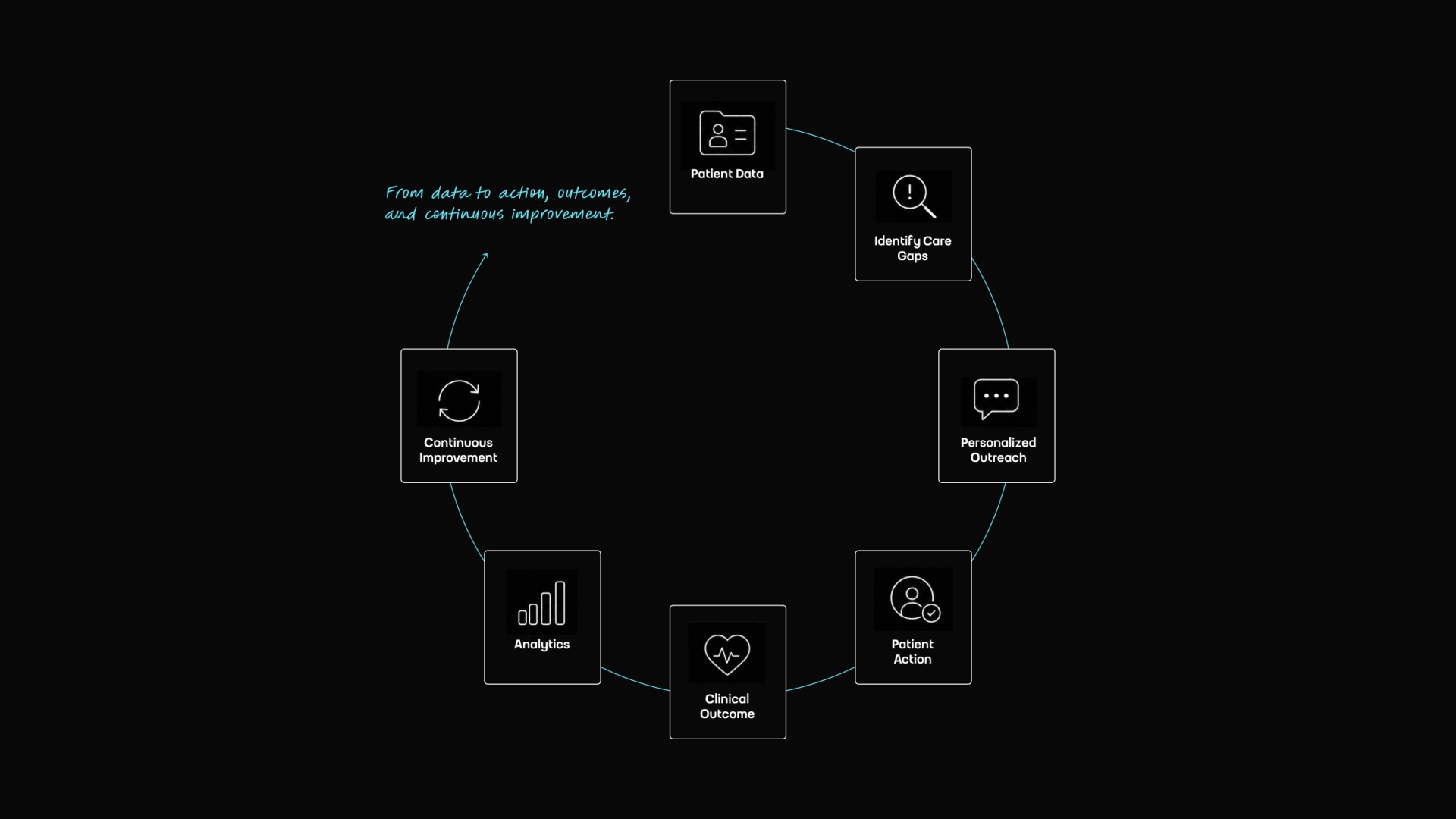
They are not the same thing. Sending an SMS reminder isn't patient engagement. Neither is sending an email. Nor is giving patients access to another portal. Communication is an activity. Engagement is an outcome.
Imagine two healthcare organizations.
Both send appointment reminders. Both offer mobile apps. Both allow patients to message their care team. On paper, they appear identical.
But six months later, one organization reports significantly higher completion rates for preventive screenings, stronger participation in chronic disease management programs, and fewer missed appointments.
What has changed?
Not the communication channels. The workflow behind them. Successful patient engagement platforms don't simply send messages.
They determine:
- who needs attention,
- why they need it,
- when they should be contacted,
- which channel is most appropriate,
- what action should be encouraged,
- and whether that action actually happened.
That last point is often overlooked. Healthcare organizations don't benefit because a reminder was delivered. They benefit because a patient completed a mammogram.
Or attended an annual wellness visit. Or started managing their diabetes before complications developed.
Patient engagement should always be measured by patient behavior, not by the number of emails sent.
Why Patient Engagement Has Become a Strategic Priority
Healthcare is changing.
Across both public and private healthcare systems, the industry is moving away from treating illness and toward preventing it. That shift changes how success is measured.
Instead of asking,
"How many patients did we treat?"
organizations increasingly ask,
"How many patients stayed healthy?"
Preventive care only works if patients participate. Population health initiatives only work if patients respond. Value-based care only works if patients remain engaged over time. This is particularly challenging in large populations, where manual outreach quickly becomes impossible.
Healthcare organizations may need to coordinate preventive care for hundreds of thousands of patients spread across multiple providers, insurance plans, and community organizations.
That complexity explains why patient engagement has evolved from a communication tool into a core healthcare platform. It connects clinical workflows, patient outreach, analytics, and care management into one continuous process.
In BigHeart's work with Medicaid populations, engagement wasn't treated as a marketing campaign or a messaging system. It became an operational capability supporting preventive care, care coordination, and long-term health improvement across large patient populations.
Patient Portals vs Patient Engagement Platforms
This distinction deserves its own discussion because the two concepts are frequently used interchangeably.
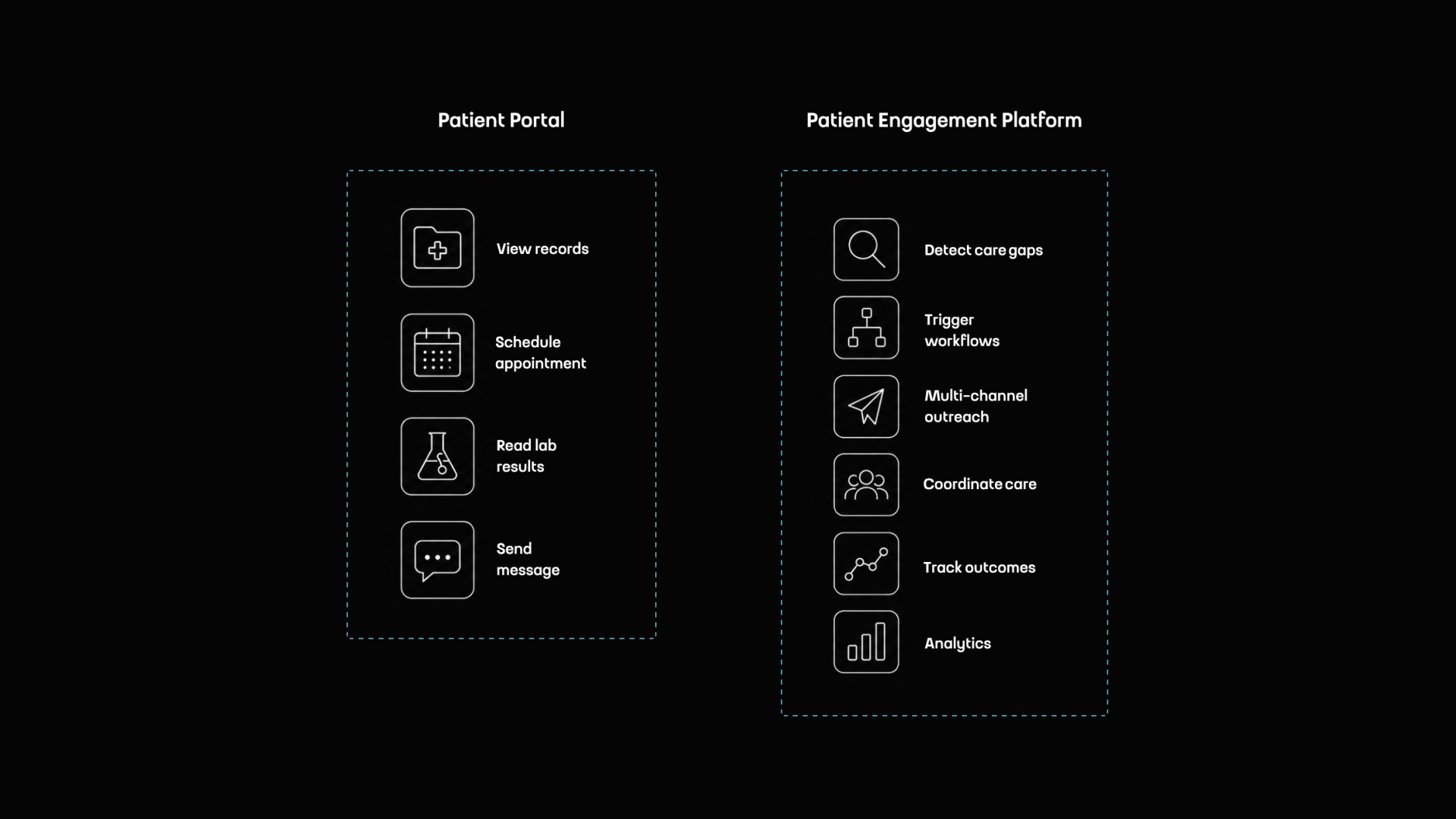
They shouldn't be. A patient portal is designed to provide access. A patient engagement platform is designed to influence behavior.
Patient portals are largely passive. Patients decide when to log in. Patient engagement platforms are proactive. They continuously identify opportunities to improve care.
Consider a patient with diabetes.
A portal might display recent glucose readings and upcoming appointments. A patient engagement platform asks different questions:
- Has the patient uploaded glucose readings recently?
- Are they overdue for an HbA1c test?
- Have they missed previous appointments?
- Is a care manager already involved?
- Should an outreach happen today?
- Which communication channel has historically produced the best response?
Those questions require far more than a messaging application.
They require data integration, workflow automation, analytics, and care coordination working together behind the scenes. That's why patient engagement platforms are fundamentally operational systems - not communication tools.
The Five Building Blocks of a Modern Patient Engagement Platform
If you look at the marketing websites of most patient engagement vendors, you'll find long feature lists.
- Appointment reminders.
- Messaging.
- Video consultations.
- Patient education.
- Forms.
- Surveys.
While all these capabilities are useful, they don't explain why some engagement platforms succeed while others fail.
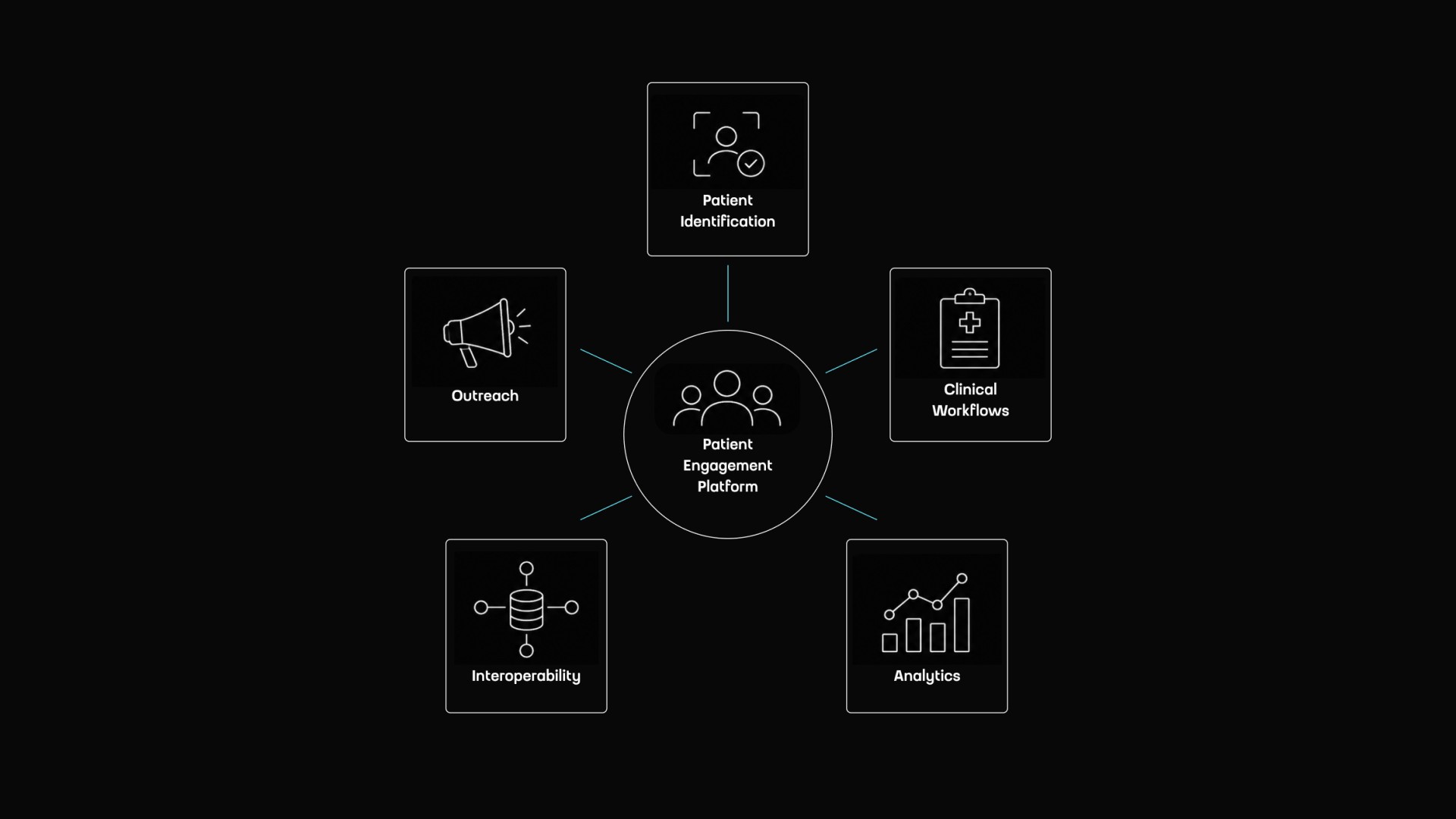
After analyzing BigHeart's approach and our own experience developing healthcare software, we've found that successful patient engagement platforms are built around five core capabilities. Everything else is built on top of them.
1. Patient Identification: Knowing Who Needs Attention
Every engagement workflow begins with one simple question:
Which patient needs our attention today?
That sounds obvious. In reality, it's one of the hardest problems in healthcare. Imagine a healthcare organization responsible for 500,000 patients. Every day, thousands of events happen simultaneously.
Someone is discharged from the hospital. Another patient misses a screening. Someone becomes eligible for an annual wellness visit. A diabetic patient hasn't uploaded glucose readings for three weeks. Another patient changes insurance coverage. Without software, identifying these patients manually is impossible.
A patient engagement platform continuously analyses clinical and operational data to determine who requires intervention and why. Rather than treating every patient the same, the platform prioritizes people who are most likely to benefit from immediate outreach.
As Charles explained, BigHeart's objective wasn't simply to contact patients. The platform was designed to identify care gaps and encourage activities such as annual wellness visits, preventive screenings, and other interventions that improve long-term outcomes.
2. Intelligent Outreach Across Multiple Channels
Once the right patient has been identified, the next question becomes:
What's the best way to reach them?
Many healthcare organizations still rely heavily on a single communication channel. Usually email. Or SMS. Sometimes outbound calls. The problem is simple. Patients are not identical.
An elderly Medicaid beneficiary may respond best to a phone call. A younger patient may prefer SMS. Someone else may only engage after speaking with a Community Health Worker. Large healthcare populations require flexibility.
Successful patient engagement platforms orchestrate communication across multiple channels while maintaining a complete history of every interaction.
Charles described how community engagement specialists complemented digital communication, recognizing that some patient populations require far more than automated reminders to remain engaged.
The objective isn't sending more messages. It's increasing the probability that the patient actually takes action.
3. Turning Communication Into Clinical Outcomes
This is where many digital health products stop. A message is delivered. The platform records that it was opened. Success.
Healthcare doesn't work that way. Sending a reminder has no clinical value. Completing the recommended action does.
A mature patient engagement platform therefore tracks outcomes rather than communications. Did the patient:
- complete their Health Risk Assessment?
- attend the appointment?
- receive the recommended screening?
- visit their primary care physician?
- complete the referral?
Every completed activity closes a care gap. Every missed activity represents another opportunity for intervention. Instead of measuring email open rates, healthcare organizations begin measuring patient outcomes.
That is the difference between communication software and patient engagement software.
4. Healthcare Interoperability
If patient identification is the brain of the platform, interoperability is its nervous system. Healthcare data rarely exists in one place. A patient's journey may involve:
- an Electronic Health Record
- a payer platform
- laboratory systems
- pharmacy systems
- scheduling software
- remote patient monitoring devices
- hospital admission systems
- claims databases
None of these systems were necessarily designed to communicate with each other. Yet patient engagement depends on understanding the complete picture. Suppose a patient is discharged from the hospital. That single event should trigger an entirely new workflow. A follow-up appointment may need to be scheduled. A care manager notified. Medication adherence monitored. Educational content delivered.
None of this happens automatically unless the platform receives and interprets the discharge event.
Charles highlighted the importance of integrating admissions, discharges, transfers, eligibility information, and patient history to support timely interventions and coordinated care.
From an engineering perspective, interoperability isn't another feature. It's the foundation that makes every other engagement workflow possible.
5. Continuous Learning and Improvement
Patient engagement isn't a one-time campaign. It's an ongoing operational process. Healthcare organizations constantly ask questions like:
- Which outreach channel generates the highest response rate?
- Which patient populations are least engaged?
- Which interventions reduce avoidable hospitalizations?
- Which care managers consistently achieve better outcomes?
- Which preventive programs actually improve participation?
Without measurement, those questions remain unanswered. Without answers, improvement becomes impossible.
BigHeart emphasized reporting and analytics not as management dashboards, but as tools for continuously refining patient engagement strategies and understanding what actually works across large healthcare populations.
The most successful platforms don't simply automate workflows. They learn from them.
One Important Observation
Notice something.
Only one of these five building blocks is visible to patients. Everything else happens behind the scenes. Patients don't see interoperability. They don't see workflow orchestration. They don't see analytics. They don't see care gap engines.
But those hidden capabilities determine whether the patient receives the right intervention at exactly the right moment. This is one of the reasons why building a patient engagement platform is far more complex than building a healthcare mobile application.
It's not primarily a user interface challenge, but a real engineering challenge.
Building a patient engagement platform?
Whether you're creating a new digital health product or modernizing an existing healthcare platform, building patient engagement capabilities requires much more than messaging and appointment reminders.
Our healthcare engineering team has spent years developing platforms supporting large-scale patient engagement, interoperability, care management, and population health initiatives.
FAQs
What is a patient engagement platform?
A patient engagement platform helps healthcare organizations encourage patients to actively participate in their healthcare journey through personalized communication, workflow automation, care coordination, and analytics.
How is a patient engagement platform different from a patient portal?
Patient portals primarily provide patients with access to information, while patient engagement platforms proactively encourage patients to complete healthcare activities such as appointments, screenings, and chronic disease management.
What features should a patient engagement platform include?
Modern platforms typically include patient identification, multi-channel communication, workflow automation, interoperability, analytics, care management, and reporting capabilities.
Why is patient engagement important?
Higher patient engagement is associated with improved preventive care, better chronic disease management, higher treatment adherence, and improved healthcare outcomes.
Can patient engagement platforms integrate with EHR systems?
Yes. Most enterprise platforms integrate with Electronic Health Records using standards such as HL7 and FHIR, enabling providers to coordinate patient care across multiple systems.
Who uses patient engagement platforms?
Healthcare providers, insurers, accountable care organizations, population health teams, digital health startups, and remote patient monitoring providers all use patient engagement platforms to improve patient participation and healthcare outcomes.
What industries benefit from patient engagement software?
Patient engagement platforms are widely used across hospitals, primary care, payer organizations, value-based care programs, remote patient monitoring, chronic disease management, and digital therapeutics.