Why Healthcare Engagement Is More Than SMS Reminders


Listen to the article
Prefer listening over reading? Press play to hear the full article.
SMS has become one of the most common ways for healthcare organizations to communicate with patients. It is inexpensive, immediate, and familiar to almost everyone. A reminder about an upcoming appointment or an overdue health assessment can reach thousands of people without requiring thousands of phone calls.
For many patients, that may be enough. They receive the reminder, understand what they need to do, and take the appropriate action.
The difficulty begins with everyone who does not.
A patient may ignore the message, have an outdated phone number, struggle to understand what is being asked of them, or have other priorities that make preventive healthcare relatively unimportant at that moment. Some patients may need several attempts before they respond. Others may require a conversation with someone who can explain why a particular healthcare activity matters.
These challenges become particularly important when healthcare organizations work with populations that are already difficult to reach.
BigHeart's work with Medicaid recipients in Illinois provides a useful example. Its engagement model combines SMS with phone calls, automated outreach, and, when necessary, in-person outreach. The objective is to help members complete preventive healthcare activities and address gaps in their care.
That experience raises a broader question for healthcare organizations developing patient engagement programs: what should happen when sending the message is the easy part?
About This Article
This article is based on our conversation with Charles Oyibo, Principal at BigHeart, about the company's approach to healthcare engagement and its work supporting Medicaid populations in Illinois.
Touch4IT has worked alongside BigHeart for more than six years, helping develop and evolve the technology supporting its healthcare operations.
Charles describes BigHeart as an engagement engine that helps healthcare organizations reach individuals and encourage them to take specific actions, including completing annual health assessments, scheduling physician visits, monitoring health indicators, and participating in health programs. BigHeart combines technology with Community Engagement Specialists and several outreach methods to support this process.
The Illinois program offers a particularly useful case study because BigHeart works with more than half a million Medicaid recipients, including people whom Charles specifically describes as hard to reach.
This article draws on that experience to examine what healthcare engagement requires once organizations move beyond digital reminders.
🎙️ Listen to the full conversation with Charles Oyibo here.
Why SMS Became So Important in Healthcare
Healthcare organizations rely heavily on SMS for good reasons.
The channel is relatively simple to deploy, patients don't need to install another app, and messages can be incorporated into automated workflows. At scale, this lets healthcare organizations communicate with large populations without the staffing requirements of calling every patient individually.
SMS also works well for interactions where the patient's next step is straightforward. Appointment reminders are the obvious example. If someone already intends to attend an appointment, a message the day before can provide useful information and reduce the chance that they forget.
Patient engagement becomes more difficult when the healthcare organization is trying to change behavior rather than remind someone about a decision they have already made.
Someone who has not completed an annual health assessment may need to understand why it matters. A patient with an open care gap may need help arranging a screening. Someone who has repeatedly failed to respond may require a completely different form of contact.
The further the organization moves from reminding patients toward activating them, the more limited a single communication channel becomes.
Reaching a Patient and Engaging a Patient Are Different Challenges
Charles uses the word "activate" to describe BigHeart's approach.
The distinction is useful because reaching someone can be measured relatively easily. A message can be delivered, an email opened, or a telephone call answered.
The healthcare objective usually comes later.
BigHeart's partners want members to complete activities that improve health outcomes. Charles gives examples, including annual health assessments, physician visits, monitoring blood pressure and weight, and participation in health programs.
This means an engagement program must follow up after the initial contact. If a patient answers the phone but never completes the recommended screening, the healthcare objective remains unresolved.
The same issue appears with digital engagement metrics. Delivery rates, open rates, and response rates can tell an organization whether communication is reaching people, but they cannot independently show whether the intended healthcare activity took place.
For healthcare organizations designing engagement programs, the meaningful unit of success therefore depends on the objective. An appointment campaign should ultimately care about completed appointments. A preventive screening program should care about screenings. A health assessment initiative should care about completed assessments.
Communication metrics help explain how patients move toward those outcomes, but they should not replace them.
Different Patients Require Different Forms of Outreach
One of the most interesting aspects of the Illinois Medicaid example is the range of outreach methods involved.
Charles describes SMS and telephone outreach alongside a mobile channel involving people who can physically visit Medicaid recipients. BigHeart also uses Community Engagement Specialists supported by automated outreach campaigns.
There is an important operational reason for having several options available. A large patient population contains people with very different circumstances and communication preferences.
One patient may respond immediately to a text message. Another may ignore several messages but answer a telephone call. Someone else may be difficult to reach through either channel.
The engagement process needs enough flexibility to accommodate these differences while remaining manageable for the healthcare organization.
Technology can help by automating the interactions that do not require human involvement and giving engagement teams visibility into previous attempts. Human outreach can then be concentrated on situations where a conversation or additional support is more likely to make a difference.
At population scale, deciding when to move from one outreach method to another becomes part of the engagement program's design.
Hard-to-Reach Populations Change the Economics of Engagement
Charles repeatedly emphasizes that some Medicaid members in the Illinois program are difficult to reach. This matters because the value of engagement is closely connected with the healthcare activities the state wants members to complete.
Preventive healthcare provides the economic rationale.
The program encourages members to complete health assessments and identify gaps that may require activities such as mammograms, annual physical examinations, or other forms of preventive care. Charles explains that addressing these needs earlier can help prevent or delay chronic illness, which may be considerably more expensive to manage later.
That changes how we should consider the cost of outreach.
A phone call costs more than an automated SMS. Sending someone to engage a member in person costs even more. Looking only at the cost of the communication channel would therefore make automation appear preferable in almost every situation.
Healthcare economics can change the calculation. If additional outreach helps a high-risk or difficult-to-reach patient complete an important preventive intervention, the value of that intervention may justify considerably more effort than sending another automated reminder.
This is why engagement strategies need to account for the healthcare objective and the population being served. The cheapest communication method and the most effective engagement method will not always be the same.
Human Outreach Still Matters in Digital Healthcare
The continued importance of people can seem surprising given how much healthcare technology has improved.
Automated campaigns can reach large populations, identify patients who need attention, and deliver communications at a scale that would be impossible manually. These capabilities are essential when programs involve hundreds of thousands of people.
Human interaction becomes valuable when the reason for non-engagement requires understanding rather than another notification.
A patient may have questions about the requested healthcare activity. They may need help scheduling an appointment or finding an appropriate provider. They may have received previous messages without understanding their significance. In some situations, the barrier may have little to do with healthcare itself.
BigHeart's model combines automated outreach with Community Engagement Specialists for precisely this reason. Technology supports the scale of the operation while people can handle interactions that require conversation and judgment.
Designing these approaches together lets automation reduce unnecessary manual work without assuming every patient can move through the same digital process.
Sometimes the Barrier Has Nothing to Do With Communication
Better outreach cannot solve every engagement problem.
Charles describes BigHeart's healthcare services as being integrated with social services that address factors such as housing and transportation. These social determinants of health can strongly influence whether someone can act on healthcare advice.
Transportation provides a straightforward example. A healthcare organization may successfully contact a patient, explain the importance of a preventive examination, and schedule the appointment. If the patient cannot reach the healthcare facility, further reminders are unlikely to solve the problem.
This is where understanding the reason behind non-participation becomes important.
A patient who forgot an appointment has a different problem from someone who cannot afford transportation. Someone who does not understand why a screening matters needs different support from someone whose contact information is outdated.
Healthcare engagement programs become more effective when they can distinguish between these situations and give care teams appropriate ways to respond.
The communication channel remains important, but the information gathered through that communication can be equally valuable. It helps the organization understand what is preventing the patient from moving forward and what kind of intervention may actually help.
Engagement Should Escalate Based on Patient Response
A large healthcare organization cannot begin every engagement with a phone call or an in-person visit. At the same time, repeatedly sending automated messages to someone who has already ignored them is unlikely to change the outcome.
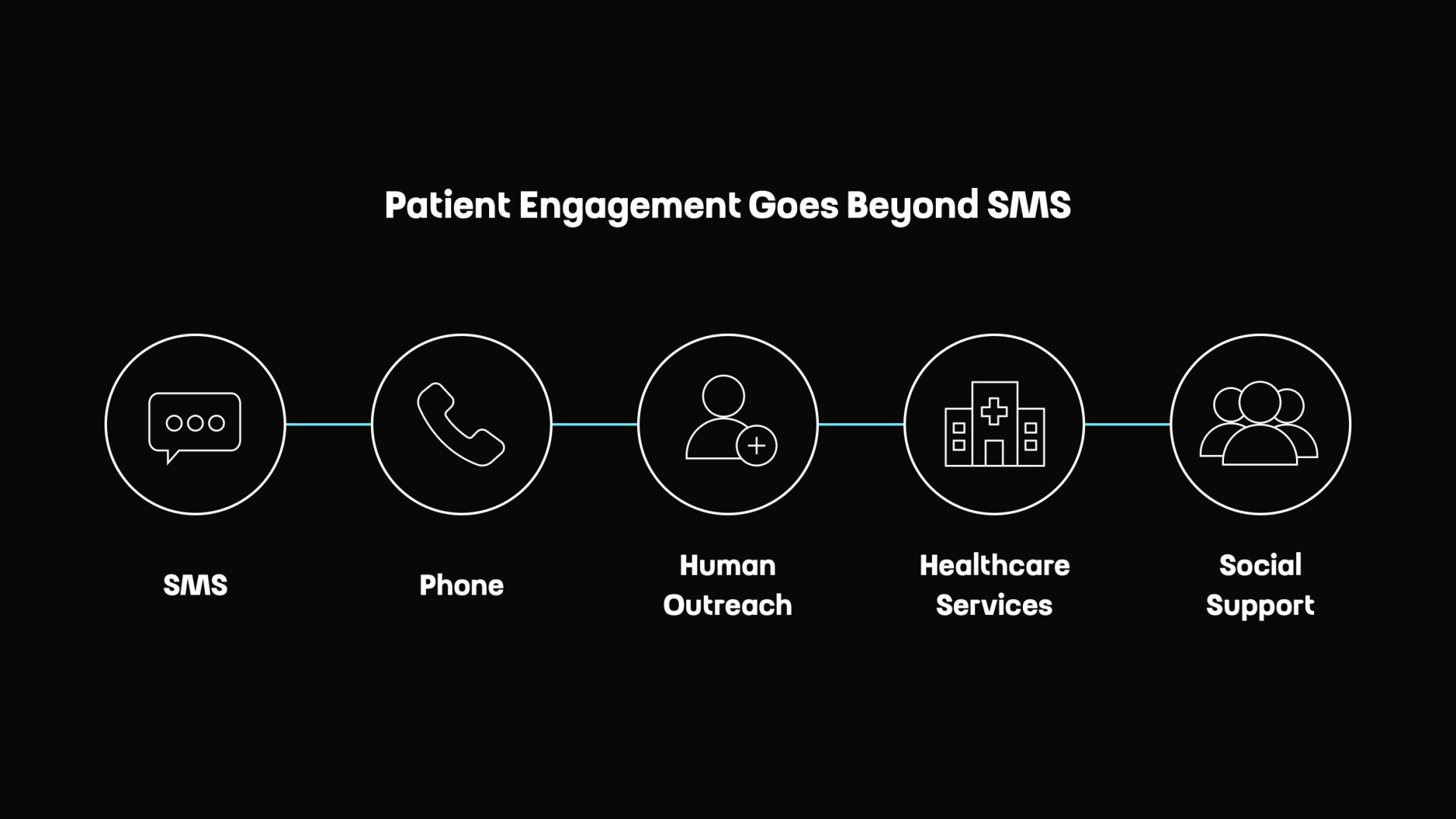
A more practical model is to change the engagement method based on what happens after each attempt. SMS can handle straightforward communication at scale. Patients who do not respond may require a phone call, while a smaller group may need more direct support from an engagement specialist. BigHeart uses this combination of automated campaigns, telephone contact, and in-person outreach in its work with Medicaid recipients in Illinois.
For the organization running the program, this creates an important operational requirement. Previous engagement attempts must be visible so the next action reflects what has already happened. If a member has received several messages without responding, the system should help the engagement team recognize that history rather than simply placing the person into another generic campaign.
The appropriate sequence will vary by population and healthcare objective. What matters is that different channels form part of a coordinated process. This lets relatively inexpensive automated communication handle simple cases while directing human effort to people who need more support.
Engagement Has to Connect With the Next Healthcare Action
Getting someone to respond is only an intermediate step. The healthcare organization still needs to help the patient complete whatever activity prompted the outreach.
In the Illinois program, these activities can include annual health assessments, physical examinations, mammograms and other interventions associated with identified care gaps. Charles also describes physician visits as an important part of this process. When a patient needs to see a doctor, engagement may ultimately lead to a scheduled and completed medical visit.
This makes the connection between engagement and healthcare delivery particularly important.
Consider a member who responds to outreach about an overdue screening. If the engagement team cannot help that person understand what they need, find the appropriate service, or move toward an appointment, the conversation may still end without the screening taking place.
Healthcare engagement therefore works best when outreach teams have enough information and operational support to move the patient forward. The experience should connect communication with the services, referrals, and workflows that come afterward.
For digital health companies building engagement functionality, this distinction matters. Sending communications is relatively straightforward. Supporting the journey from identifying a healthcare need to taking appropriate action requires much deeper connections between data, software, and healthcare operations.
Care Gaps Give Engagement a Purpose
The BigHeart platform integrates with external healthcare systems to access information such as insurance eligibility, health history, diagnoses and care gaps. Charles explains that these integrations support healthcare delivery through the platform.
Care gap information is particularly relevant to engagement because it gives a reason to contact someone.
Rather than treating a patient population as a marketing audience, the organization can identify people who may require a particular healthcare action. A patient may need an annual physical. Another may be overdue for a mammogram. Someone else may need follow-up after moving between care settings.
The outreach can then connect to an identifiable healthcare need.
This also changes what engagement teams need from technology. They need enough patient context to understand why an individual appears in their workflow, what action may be required, and what has already happened. Without that context, even a successful conversation can leave the person conducting the outreach with limited ability to help.
The quality of engagement therefore depends partly on the quality and availability of the information behind it. Better communication cannot compensate for a system that does not know why the patient needs attention.
Engagement at Medicaid Scale Requires Operational Infrastructure
The Illinois example also shows how quickly these questions become operational challenges when the population grows.
Charles describes BigHeart's work as reaching a little over half a million Medicaid recipients through channels including SMS, telephone calls, and direct outreach. The program is intended to encourage activities such as annual health screenings and help identify healthcare gaps that need to be addressed.
At that scale, even relatively simple engagement processes generate significant activity.
Some members respond immediately. Others require several attempts. Contact information may be incomplete. A care gap may already have been resolved elsewhere. Someone may need a referral or appointment. Another person may require help with a social issue before they can access care.
Managing these situations requires more than sending messages to a large database. The organization needs to know who needs attention, why, what communication has already taken place, and what should happen next.
This is where engagement becomes closely connected with care operations. Technology must help teams manage a large number of individual patient situations without forcing staff to manually reconstruct the history every time they interact with someone.
The scale of Illinois' population makes that requirement especially visible, but the same principle applies to smaller programs. As patient volumes increase, processes that were manageable through spreadsheets, disconnected tools, or individual knowledge become increasingly difficult to maintain.
Measure Healthcare Actions, Not Communication Volume
Reporting becomes important for another reason. Healthcare organizations need to understand whether their engagement efforts are leading toward the activities the program was designed to encourage.
An SMS platform can report how many messages were sent. A call system can record attempts and completed conversations. These are useful operational metrics, but they describe communication rather than healthcare outcomes.
Charles describes reporting and analytics as one of BigHeart's core capabilities, intended to generate insights that can improve future offerings.
For an engagement program, the relevant measures should therefore reflect its healthcare objectives. If the purpose is to encourage annual assessments, completed assessments matter. If the program addresses preventive care gaps, the organization needs visibility into whether those activities were ultimately completed. If outreach is intended to connect patients with physicians, the progression toward those visits becomes important.
Communication metrics still have a role. They can help explain where a process is struggling. A low response rate may suggest that a particular channel is ineffective for part of the population, while repeated unsuccessful contact attempts may indicate that another approach is needed.
The key is to connect those metrics to what happens afterward. Otherwise, an organization can become very efficient at sending communications without knowing whether the engagement program is achieving its healthcare purpose.
What Healthcare Organizations Should Consider When Designing Engagement Programs
Healthcare organizations planning an engagement program should start with the action they want patients to take and work backward from there.
That means understanding which patients should be contacted, what information determines their eligibility for the program and which healthcare need triggered the outreach. The organization also needs to decide what should happen when someone responds, when they do not respond, and when the original communication reveals another problem.
Channel strategy should follow from those questions. SMS may be entirely appropriate for a large proportion of the population. Telephone outreach can support patients who need a conversation. Reserve human engagement for situations where additional assistance is justified.
The organization should also consider what information staff will need during those interactions. A person conducting outreach becomes much more useful when they understand the reason for contact and can help the patient move toward an appropriate next step.
Finally, reporting should be designed around the healthcare objective from the beginning. The organization should know what successful engagement means before building the campaign, rather than deciding later which communication metrics can demonstrate performance.
These decisions influence the technology required to support the program. They determine which systems need to exchange information, what workflows need to exist, which actions should be automated, and where people need to become involved.
From SMS Reminders to an Engagement System
SMS remains an extremely useful healthcare communication channel. The problem arises when the communication channel becomes confused with the engagement strategy itself.
A mature engagement model needs to accommodate the different ways patients respond. It needs enough healthcare context to understand why someone should be contacted, multiple ways to reach people when the first attempt doesn't work, and a practical path from communication to the healthcare service being encouraged.
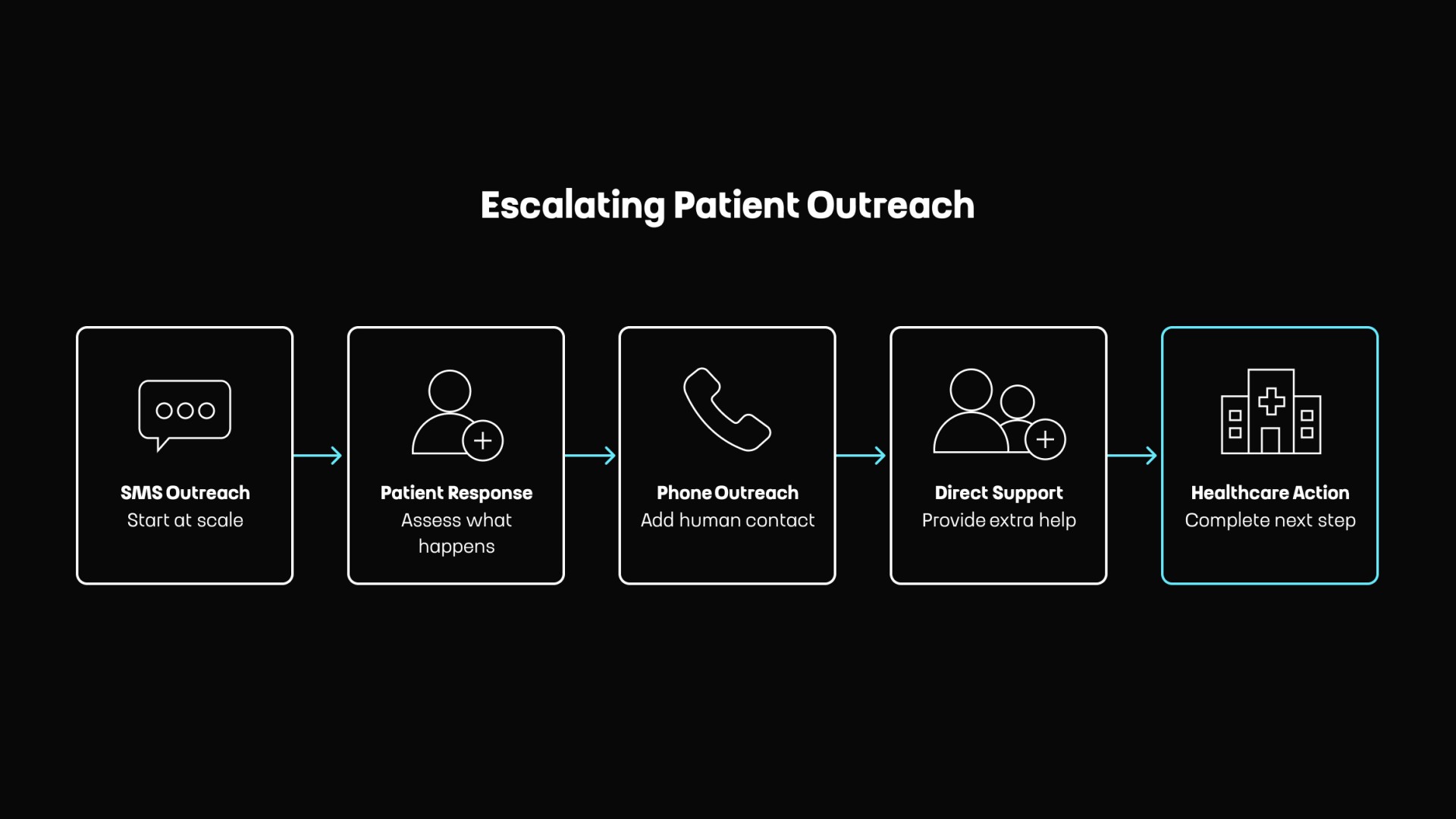
BigHeart's approach illustrates how these capabilities can come together. Its model combines external healthcare data, automated campaigns, Community Engagement Specialists, several outreach channels, integrated health and social services, and reporting and analytics. Charles presents these capabilities collectively as the foundation of BigHeart's engagement offering.
For healthcare organizations, the broader lesson is that engagement should be designed around the patient journey and the healthcare action that needs to happen. The SMS is simply one possible point of contact within that process.
Final Thoughts
Digital communication has made it possible for healthcare organizations to reach patients at a scale that would have been difficult to achieve through manual outreach alone. SMS deserves an important place within that model because it is simple, inexpensive and effective for many interactions.
Large healthcare populations, however, contain people with very different needs and circumstances. Some respond to a reminder immediately. Others need a conversation, practical assistance or several attempts through different channels. In some cases, the barrier preventing someone from receiving care may sit outside the healthcare system altogether.
The Illinois Medicaid example is particularly useful because these challenges have to be addressed across a population of more than half a million people. BigHeart's response combines technology with human engagement and connects outreach with healthcare data, preventive care activities, and social services.
For healthtech companies, providers, and payers building their own engagement capabilities, the starting question should be what they want the patient to do and what might prevent them from doing it. They can then design the communication channel around that reality.
Building Patient Engagement Technology?
Touch4IT has worked alongside BigHeart for more than six years, developing technology that supports patient engagement, care management, telehealth, EHR functionality, healthcare integrations, and analytics.
We work with healthcare organizations and digital health companies that need to turn complex patient and care workflows into software that can operate reliably at scale.
If you are building or expanding patient engagement technology, talk to Jan, our healthcare lead.
FAQ
What is patient engagement in healthcare?
Patient engagement describes the process of helping patients participate actively in their healthcare. This can include completing health assessments, attending appointments, receiving preventive screenings, monitoring health indicators and participating in health programs. Effective engagement requires healthcare organizations to identify who needs attention, reach them through appropriate channels, and help them complete the relevant healthcare action.
Why are SMS reminders alone not enough for patient engagement?
SMS works well for many routine interactions, particularly appointment reminders and straightforward notifications. However, some patients do not respond to messages or require additional support before taking action. Healthcare organizations may therefore need to combine SMS with phone calls, engagement specialists, and other forms of outreach, particularly when working with harder-to-reach populations. BigHeart uses several of these approaches in its work with Medicaid recipients in Illinois.
What is multichannel patient engagement?
Multichannel patient engagement uses several communication methods to reach patients rather than relying on a single channel. These can include SMS, telephone calls, digital communication, and direct human outreach. The right channel depends on the patient, the healthcare activity being encouraged, and how the person responded to previous contact attempts.
How can healthcare organizations engage hard-to-reach patients?
Healthcare organizations can combine automated communication with more direct forms of support. BigHeart's Illinois Medicaid program, for example, uses SMS, telephone calls, and in-person outreach to reach members and encourage activities such as annual health screenings and addressing identified care gaps. Technology can help identify who needs attention and track previous interactions, while staff can support patients who need a conversation or additional assistance.
What role do social determinants of health play in patient engagement?
Factors such as transportation, housing, and access to social services can affect whether a patient can follow healthcare recommendations. A patient may understand they need an examination but still be unable to attend because of a practical barrier. Charles describes BigHeart's approach as connecting healthcare services with social services to help address these wider factors.
How should healthcare organizations measure patient engagement?
Healthcare organizations should connect engagement metrics with the healthcare activity the program is intended to encourage. Message delivery, response rates, and completed calls provide useful information, but measures such as completed assessments, appointments, screenings, and addressed care gaps better indicate whether outreach is helping patients take the intended action.