How Healthcare Startups Integrate with Epic and Other EHR Systems


A digital health startup develops an application that helps patients manage diabetes. Patients can record their glucose levels, communicate with care coordinators, and receive personalized recommendations. The product works well, and the company begins discussions with a large US healthcare organization about deploying it across thousands of patients.
Then comes a question that can significantly complicate the project: Can your platform integrate with our EHR?
The healthcare organization already uses Epic to manage patient records, appointments, medications, laboratory results, and clinical documentation. Its physicians spend much of their workday in that system. They cannot realistically switch between several disconnected applications, manually transfer patient information, or repeatedly document the same activities.
For the startup, this means its application must become part of an existing healthcare technology environment. Patient identities need to match, clinical information must be exchanged securely, and the right data must reach the right people at the right time.
This is one of the most important technical challenges facing digital health companies entering or expanding within the US healthcare market.
Why EHR Integration Matters for Healthcare Startups
Electronic Health Record (EHR) systems are central to how healthcare organizations operate. They store clinical information and support workflows involving physicians, nurses, administrative staff, and other healthcare professionals.
An EHR can contain a patient's medical history, diagnoses, medications, allergies, laboratory results, clinical notes, treatment plans, and encounters. Many systems also support appointment scheduling, prescriptions, medical orders, billing, and communication with patients.
For healthcare startups, EHR integration becomes important when their products need to interact with this information or fit into the workflows of existing healthcare organizations.
Consider a remote patient monitoring company. Its application collects blood pressure readings from connected devices and identifies patients whose measurements may require clinical attention. The monitoring dashboard might work perfectly as a standalone product, but the healthcare organization still needs a way to connect those readings to the correct patient record and make relevant information available to the care team.
A similar challenge appears with AI clinical documentation tools. If an application generates a clinical note following a consultation, that note may need to be reviewed and incorporated into the healthcare organization's existing documentation workflow.
The technical requirements vary by product, but the underlying problem is consistent: healthcare organizations already have systems that manage clinical information, and new applications must work within that environment.
For startups selling software to hospitals, medical practices, and health systems, integration capabilities can therefore become an important part of product adoption and enterprise sales.
The Major EHR Systems Used in the United States
The US healthcare market includes several established EHR platforms. Understanding their differences matters because the integration environment a startup encounters will depend heavily on the organizations it serves.
Epic
Epic is a major EHR platform used by large US hospitals and health systems. It supports a broad range of clinical and administrative activities, including inpatient and outpatient care, medication management, clinical orders, scheduling, billing, and patient communication.
Epic also includes MyChart, its patient-facing portal, where patients can access selected medical information, view appointments, review test results, and communicate with healthcare professionals.
For a digital health company, Epic integration may involve retrieving patient information, exchanging clinical observations, connecting appointment workflows, or making information generated by an external application available within an existing clinical process.
The challenge is that Epic operates within a much larger healthcare environment. A hospital's implementation can involve multiple departments, specialized workflows, security policies, and locally configured processes.
Consequently, an integration that works in one healthcare organization may require additional configuration or development before it can operate in another.
Oracle Health (formerly Cerner)
Oracle Health is another important EHR provider in the US market. Its clinical systems, including PowerChart, support patient documentation, clinical information management, and workflows across healthcare organizations.
Digital health companies working with organizations using Oracle Health may encounter requirements similar to those associated with Epic: patient data exchange, access to clinical information, documentation workflows, and integration with existing operational systems.
However, the available interfaces, implementation requirements, and data structures can differ.
A startup planning to serve multiple healthcare organizations should avoid assuming that supporting one EHR automatically means its product will work with every other system.
eClinicalWorks and Other Ambulatory EHR Systems
Large hospital systems are only part of the US healthcare market. Smaller medical practices, outpatient organizations, and independent provider groups often use different EHR platforms.
eClinicalWorks is one example of an established system serving ambulatory healthcare organizations. Other platforms include athenahealth, NextGen Healthcare, and MEDITECH, which serves a range of healthcare settings.
For a startup building a product for physician practices, supporting these environments may be just as commercially important as integrating with Epic.
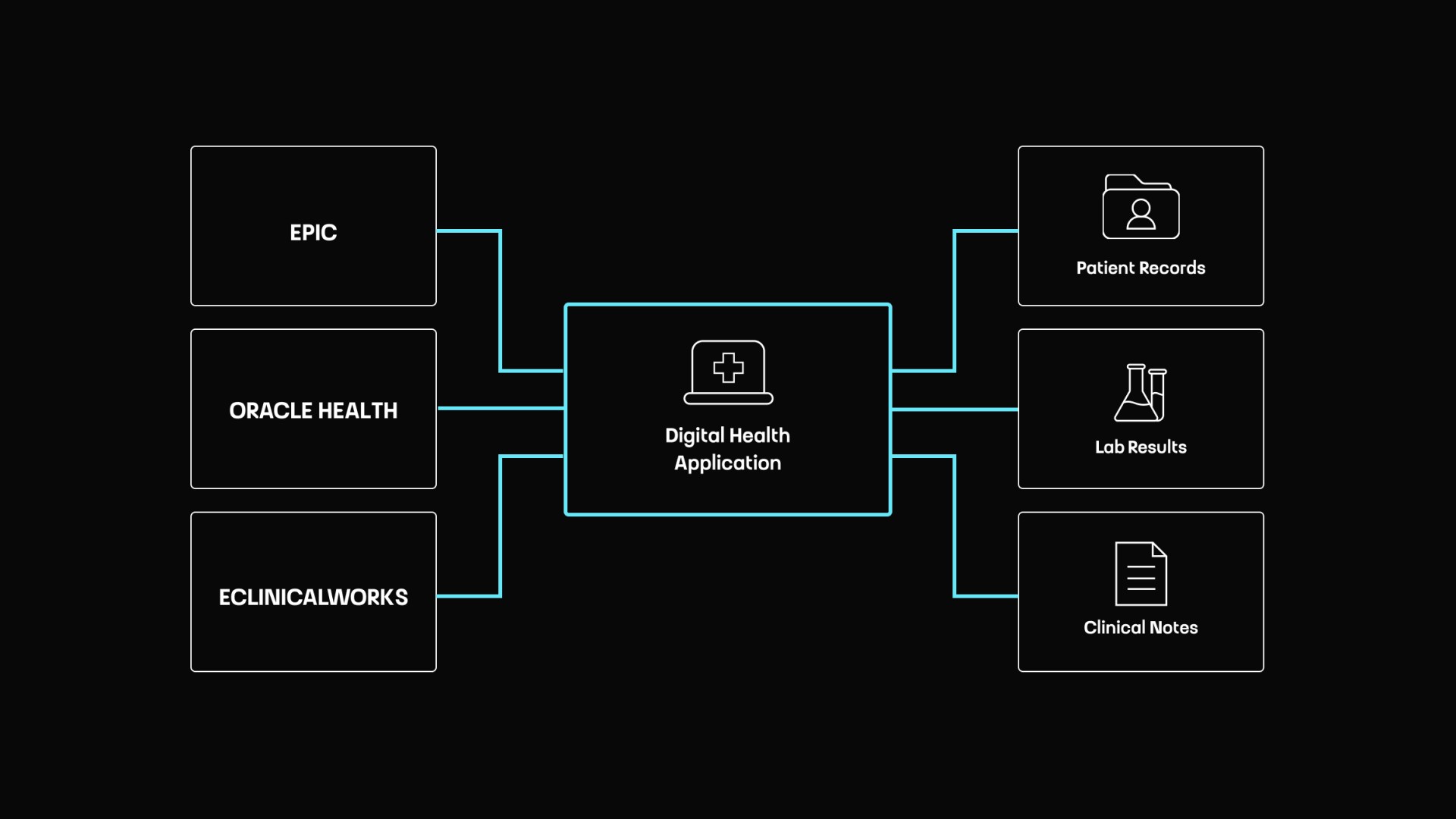
The diversity of EHR systems creates a practical engineering challenge. A company may need to support different authentication mechanisms, data exchange interfaces, clinical workflows, and customer-specific configurations while maintaining a consistent experience within its own application.
What Actually Needs to Be Integrated?
EHR integration is often discussed as though it were a single technical connection. In reality, it can involve several distinct categories of healthcare information and workflows.
Patient Demographics and Identity
Before exchanging clinical information, two systems need to establish that they are referring to the same patient.
This can involve patient identifiers, names, dates of birth, contact information, and other demographic attributes. Different systems may use different identifiers for the same individual, and records may contain incomplete or inconsistent information.
A patient could be registered under one identifier in a hospital EHR and another in a remote monitoring platform. If the systems fail to match those records correctly, information may be assigned to the wrong person or become disconnected from the patient's clinical history.
Patient identity matching is therefore a foundational requirement for many healthcare integrations.
Clinical Information
Digital health applications may need access to diagnoses, medications, allergies, vital signs, laboratory results, or other clinical observations.
For example, a chronic disease management platform might need recent HbA1c laboratory results to evaluate a patient's diabetes management progress. A medication management application may need access to a current medication list.
The application must also understand what the information represents. A numerical value without its measurement unit, clinical context, or observation date may be difficult to interpret safely.
Clinical data integration involves both transporting information and preserving its meaning.
Appointments and Encounters
Healthcare organizations use appointments and encounters to manage different aspects of patient care.
An appointment represents a scheduled healthcare interaction, while an encounter generally records an actual interaction between a patient and healthcare professionals.
A telehealth application might need to retrieve scheduled appointments, associate a consultation with the correct patient, and make information about the completed encounter available to the healthcare organization's systems.
These workflows can become complicated when appointments are rescheduled, patients do not attend, consultations involve multiple professionals, or services are delivered outside traditional clinical settings.
Clinical Documentation
Physicians and other healthcare professionals document patient care through clinical notes, assessments, orders, and other records.
An external application may generate information that needs to become part of this documentation. Examples include a telehealth consultation summary, remote monitoring report, or AI-assisted clinical note.
However, transferring information into an EHR does not necessarily mean it becomes an accepted clinical record.
Healthcare organizations may require specific document formats, clinician review, approval processes, and rules governing who can create or modify different types of clinical information.
For startups developing clinical AI products, understanding these documentation requirements is particularly important.
Orders, Results and Care Activities
Some applications need to interact with clinical orders, such as laboratory tests, imaging requests, or other services.
A healthcare workflow may involve a physician placing an order, an external laboratory performing the test, and the results returning to the EHR.
Other products may need to exchange care plans, goals, referrals, or task information associated with ongoing patient management.
These interactions require careful coordination because each system may be responsible for a different stage of the workflow.
Why EHR Integration Is More Complicated Than Connecting Two APIs
Modern software companies are accustomed to integrating services through APIs. A developer authenticates with an external system, retrieves data, and uses it within an application.
Healthcare integrations can use similar technical mechanisms, but several additional factors make them more complicated.
First, healthcare data is highly structured and context-dependent. Diagnoses, laboratory measurements, medications, and procedures rely on established clinical terminology and coding systems. An application must interpret these records correctly rather than treating them as ordinary text fields.
Second, clinical workflows differ between healthcare organizations. Two hospitals using Epic may have different configurations, documentation requirements, security policies, and integration processes.
Third, healthcare applications often need to exchange information with systems implemented at different times and using different technical standards. Some workflows use modern APIs, while others still rely on established healthcare messaging standards.
Finally, integration must account for privacy, security, and accountability. Applications handling protected health information need appropriate access controls, secure data transmission, and mechanisms for tracking how information is accessed or changed.
These requirements become especially important when a startup moves beyond its first healthcare customer. A custom integration built for one organization may not provide a scalable foundation for connecting the next ten.
How EHR Integration Affects Product Adoption
The integration requirements of healthcare organizations influence more than software architecture. They also affect implementation timelines, customer onboarding, and the commercial scalability of a digital health product.
Imagine a healthcare startup that sells an AI-powered patient intake solution to medical practices. The application collects patient information before an appointment and organizes it for clinical staff.
If the information remains in a separate dashboard, employees may need to manually transfer it into the EHR. This adds work and reduces the product's value.
If the application can exchange the appropriate information with the practice's existing system, the workflow becomes more useful. Staff can access relevant information without repeating the same administrative tasks.
The same principle applies to remote monitoring, telehealth, clinical documentation, and care coordination software.
A product that requires extensive manual work may be difficult to adopt, even when its core functionality is valuable. Healthcare organizations need confidence that new technology will fit their existing processes and avoid introducing unnecessary operational complexity.
For growing healthtech companies, the ability to deliver repeatable integrations can also influence how efficiently they onboard new enterprise customers.
An integration architecture that can be adapted across different healthcare environments may reduce the amount of custom engineering required for each deployment. However, customer-specific configuration, testing, and coordination with the healthcare organization's IT team will often remain necessary.
How Healthcare Applications Exchange Data with EHR Systems
Once a digital health company understands which EHR systems its customers use, the next question is how its application will exchange information with them.
A remote patient monitoring platform may need to retrieve patient demographics, receive laboratory results, and make new clinical observations available to physicians. A telehealth application may need access to appointments, medication lists, and patient records. An AI documentation tool may need to retrieve clinical context and return a completed note for review.
Each of these workflows involves different information, permissions, and technical requirements.
Healthcare systems have historically exchanged data through specialized messaging standards and interfaces. Modern EHR platforms increasingly support API-based approaches, although traditional integration methods remain important.
For healthcare startups, the most relevant technologies to understand include HL7 v2, FHIR, SMART on FHIR, and the clinical terminology standards used to represent healthcare information.
HL7 v2: The Established Standard for Healthcare Messaging
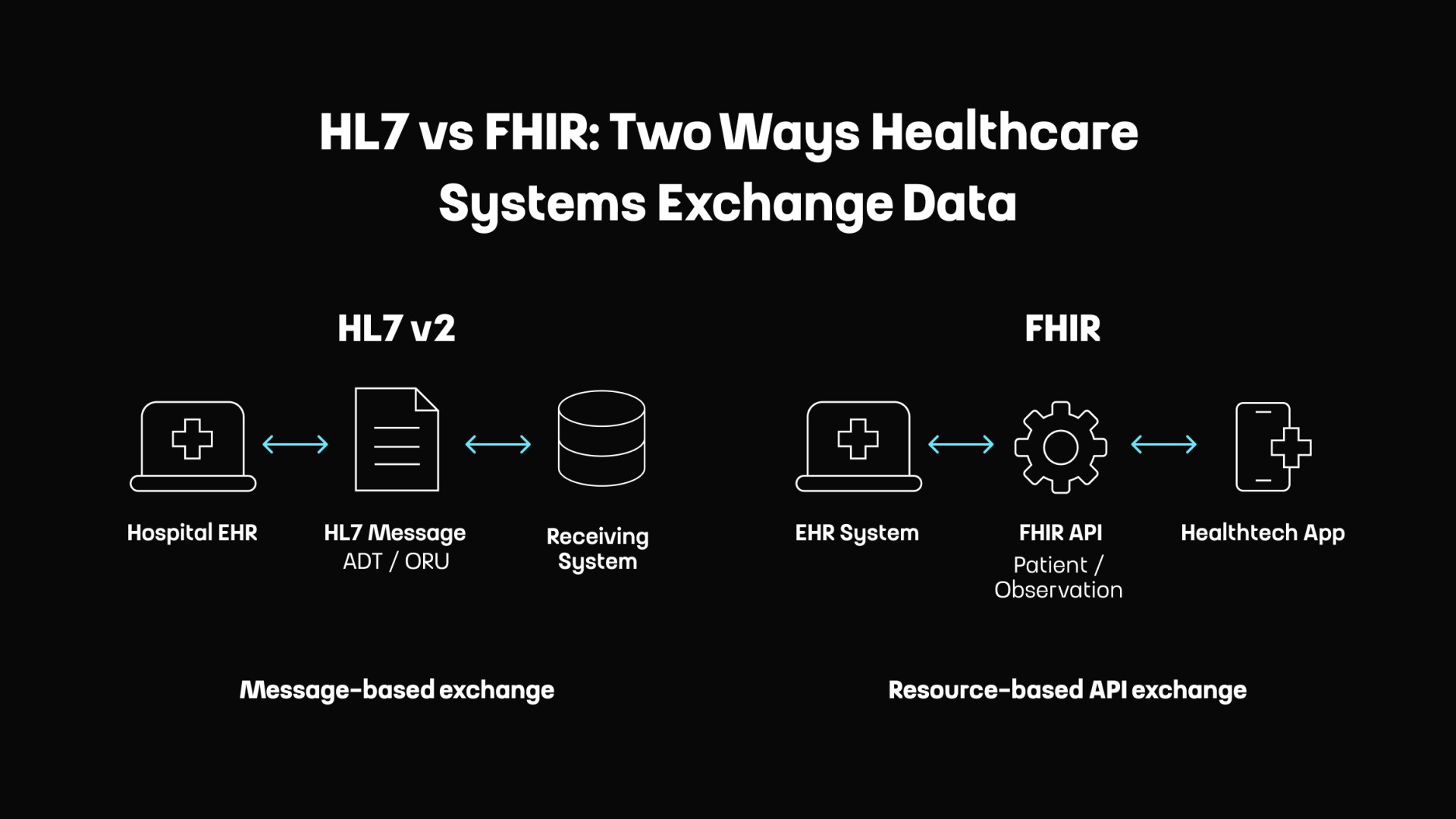
HL7 Version 2 is a widely used messaging standard that allows healthcare systems to exchange information about patients, encounters, orders, and clinical results.
It remains common in hospitals and healthcare organizations because many existing systems and interfaces were built around it.
For example, when a patient is admitted to a hospital, an HL7 ADT message can notify other connected systems about the admission. ADT stands for Admission, Discharge, and Transfer, and these messages communicate important changes in a patient's administrative or encounter information.
Other HL7 messages support laboratory orders, test results, and clinical workflows.
Consider a laboratory integration. A physician orders a blood test through the EHR. The laboratory performs the test, and the results are transmitted back to the healthcare organization. An HL7 results message may include the patient identifier, test information, measured values, units, and other details needed to link the result to the correct clinical record.
Although HL7 v2 has been used for decades, it remains relevant to startups connecting with established healthcare infrastructure.
A modern healthcare application may need to process HL7 messages even when its own internal architecture uses REST APIs and cloud-based services.
FHIR: A Modern Approach to Healthcare Data Exchange
FHIR, or Fast Healthcare Interoperability Resources, is a standard developed by HL7 to support the exchange of healthcare information through structured data models and modern web technologies.
FHIR organizes healthcare information into resources representing different clinical and administrative concepts.
For example, the Patient resource contains patient information, while Observation can represent measurements such as blood pressure or glucose levels. Encounter represents a healthcare interaction, and MedicationRequest can represent a medication order.
These resources can be exchanged through APIs, allowing authorized applications to retrieve or submit healthcare information.
A diabetes management application might use FHIR to retrieve a patient's relevant diagnoses, medications, and laboratory observations. It could then combine this information with data collected through its own patient application.
However, the availability of a FHIR API does not mean that every type of clinical information can automatically be accessed or updated.
The supported resources, operations, permissions, and implementation details depend on the EHR platform and the healthcare organization operating it.
A system may allow an external application to retrieve observations but restrict its ability to create new clinical records. Another organization may require additional review before permitting write access.
These differences need to be considered during integration planning.
SMART on FHIR: Connecting Applications to EHR Workflows
SMART on FHIR provides a framework for integrating applications with FHIR-enabled healthcare systems, including mechanisms for authorization and application launch.
One common use case involves a clinician opening an external application directly from the EHR.
Imagine a physician reviewing a patient's chart in Epic. The physician launches a connected chronic disease management application, which receives authorized context about the user and patient. The application can then retrieve relevant information through supported FHIR APIs without requiring the physician to manually search for the same patient again.
This can make external healthcare applications easier to use within established clinical workflows.
SMART on FHIR commonly uses OAuth 2.0 authorization mechanisms, with access governed by the permissions and scopes available to the application.
For startups building products for hospitals and medical practices, this approach can be valuable because it supports a more integrated user experience.
However, SMART on FHIR does not guarantee that every desired workflow is supported. Application registration, launch configuration, available scopes, and API capabilities still depend on the EHR environment.
What Epic EHR Integration Looks Like in Practice
Epic provides integration capabilities through its developer ecosystem, including APIs and other interfaces used to connect external applications with Epic environments.
For a digital health startup, the first step is to define the exact clinical workflow the integration needs to support.
Suppose a company develops a platform for monitoring patients with hypertension. Its product collects blood pressure readings from connected devices and lets care coordinators identify patients who need additional attention.
A healthcare organization using Epic wants relevant information from the monitoring platform to become available to its clinical teams.
The integration project begins by identifying which information needs to move between the systems.
The startup may need to receive patient demographic information, associate monitoring records with the correct patient, retrieve selected clinical context, and exchange relevant observations or reports.
The next step is to determine which interfaces are available in the customer's Epic environment and whether those interfaces support the required operations.
Read Access and Write Access Are Different Problems
Retrieving information from an EHR is often technically and operationally different from writing information back into it.
A startup may be able to retrieve selected patient records through a supported FHIR API, provided the necessary permissions and authorization are in place.
Writing new observations, documents, or other information into the EHR may require different interfaces, additional permissions, or a customer-specific workflow.
This distinction is important for product planning.
A startup promising customers that its platform can synchronize information with Epic needs to define exactly what synchronization means. Reading patient demographics, receiving laboratory results, submitting clinical observations, and creating signed clinical notes are different capabilities.
Each may involve separate implementation requirements.
Integrating With Existing Clinical Workflows
Technical connectivity alone does not determine whether an integration will be useful.
The information must appear in a place where healthcare professionals can act on it.
For example, sending hundreds of blood pressure readings into a clinical system may create additional work if physicians cannot easily identify which measurements require attention.
A more useful workflow might summarize the monitoring period, highlight relevant changes, and make detailed readings available when needed.
The appropriate approach depends on the clinical use case and the healthcare organization's requirements.
This is particularly important for startups developing AI applications. An AI-generated summary or clinical note must fit the organization's documentation and review process.
The application may need to preserve the original information, identify how the output was generated, and support clinician review before the information becomes part of the medical record.
The engineering team therefore needs to understand how clinicians use the EHR, how information moves through the organization, and which actions require human approval.
Clinical Terminology and Data Mapping
Even when two systems use the same interoperability standard, their data may not have identical meaning or structure.
Healthcare information relies on standardized terminology systems that help applications interpret clinical concepts consistently. In the United States, the United States Core Data for Interoperability (USCDI) defines standardized categories of health information that support interoperable data exchange.
Several coding systems are particularly relevant to US healthcare integrations.
ICD-10-CM
ICD-10-CM is used to classify diagnoses and health conditions in the United States.
A healthcare application may encounter ICD-10-CM codes when retrieving a patient's diagnoses, organizing condition-specific care plans, or supporting workflows related to claims and reimbursement.
SNOMED CT
SNOMED CT provides a detailed clinical terminology for representing healthcare concepts.
It can support structured documentation of clinical findings, conditions, procedures, and other concepts used in patient care.
For applications exchanging care plans or clinical information, SNOMED CT can help represent concepts consistently and in a machine-readable way.
LOINC
LOINC is commonly used to identify laboratory tests, clinical measurements, and observations.
A glucose measurement, for example, may be represented using a LOINC code that identifies the specific test or observation.
The measured value must also include appropriate units and other relevant context.
CPT and HCPCS
CPT and HCPCS codes are important in US healthcare billing and reimbursement workflows.
They identify medical services, procedures, and other billable items.
A healthcare application involved in care delivery or reimbursement-related reporting may need to associate clinical activities with these coding systems.
Why Mapping Matters
Consider a platform receiving blood pressure measurements from multiple sources.
One system may provide systolic and diastolic measurements as separate observations. Another may use a grouped structure. The systems may also differ in their identifiers, timestamps, and supporting information.
An integration layer needs to normalize the incoming data while preserving the clinical meaning of each measurement.
Similar challenges arise with medications, diagnoses, laboratory results, and encounter information.
For startups supporting multiple healthcare customers, these differences can become a significant source of engineering complexity.
A reliable integration architecture should account for terminology mapping, validation, missing information, and the possibility that incoming data does not match the expected structure.
Patient Identity Matching Across Healthcare Systems
Patient identity was introduced earlier as a basic integration requirement, but it becomes more complex as a product grows.
Matching is especially difficult when an application works with several healthcare organizations or receives information from external laboratories and medical devices.
Matching records solely by name is unreliable. Names may be shared, misspelled, or changed, while demographic information can be incomplete.
Healthcare integrations may use combinations of identifiers and demographic attributes, along with patient matching rules and review procedures.
Some environments also use enterprise master patient index systems to help maintain relationships between patient identities across applications.
For a healthcare startup, patient identity management should be considered early in the product architecture.
Incorrectly matched information can affect clinical workflows and create serious patient safety and privacy risks.
HIPAA, Authentication and Access Control
Applications integrating with EHR systems frequently handle protected health information, making security and privacy central engineering requirements.
HIPAA establishes important requirements for protecting health information in the United States. The precise obligations depend on the organizations involved, their roles, and the services being provided.
From a technical perspective, healthcare integrations commonly require secure communication, authentication, authorization, audit logging, and appropriate controls over access to patient information.
Authentication and Authorization
Authentication establishes the identity of a user or application. Authorization determines which information or operations that identity can access.
A physician, care coordinator, and administrative employee may require different levels of access to the same healthcare system.
An external application may also need separate permissions depending on whether it retrieves information on behalf of a clinician, accesses data through a backend service, or supports a patient-facing workflow.
Healthcare applications should request and use only the permissions necessary for their intended functionality.
Audit Trails
Healthcare systems need mechanisms for recording relevant access and changes to sensitive information.
Audit records can help establish which user or system accessed a patient record, what action occurred, and when it happened.
For applications exchanging information with EHRs, auditability becomes especially important when data is created, updated, or transferred between organizations.
Secure Data Exchange
Healthcare information must be protected during transmission and storage through appropriate technical and organizational safeguards.
This includes securely managing credentials, protecting sensitive data, controlling access to integration infrastructure, and establishing procedures for handling errors or security incidents.
A successful EHR integration must therefore be designed around both clinical functionality and the security requirements of the organizations involved.
Building an Integration Architecture That Can Scale
A startup's first EHR integration is often developed around the requirements of one customer.
This may be sufficient for an initial deployment, but it can create problems as the business expands.
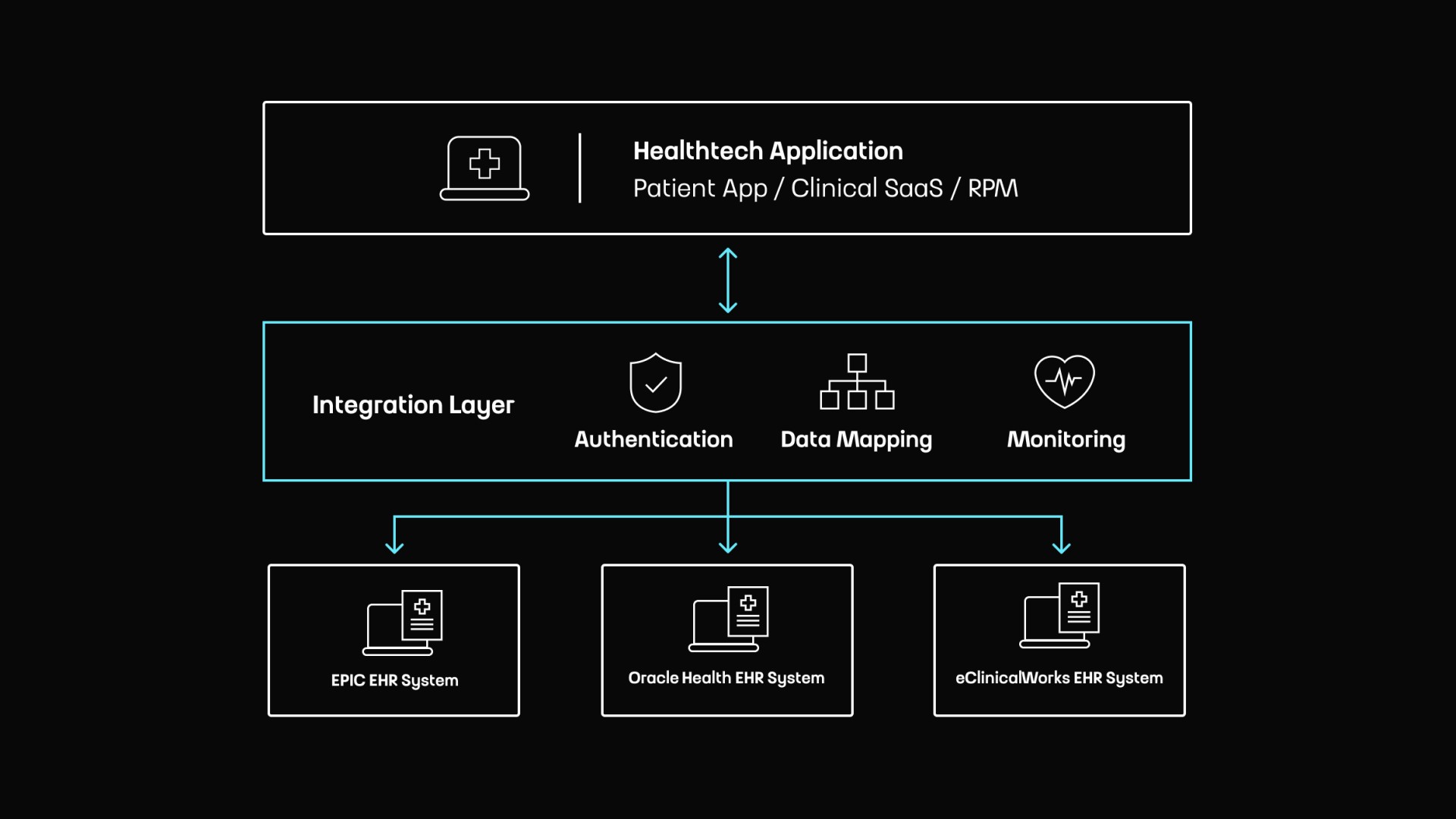
Imagine a healthcare SaaS company that first integrates with Epic for a hospital customer. Six months later, another customer uses Oracle Health, while a third operates eClinicalWorks.
If the application was built around assumptions specific to the first integration, supporting the next two customers may require substantial product changes.
A more scalable approach separates the application's core business logic from the technical details of individual EHR integrations.
An Integration Layer Between the Product and EHR Systems
An integration layer can manage communication with external healthcare systems while presenting a more consistent internal interface to the application.
For example, a patient engagement platform might need to retrieve demographic information, diagnoses, and laboratory observations regardless of which EHR a customer uses.
The integration layer can handle the specific APIs, message formats, and mapping rules associated with each external system.
The application can then work with a normalized internal representation of the information.
This approach does not eliminate differences between EHR platforms, but it can reduce the amount of EHR-specific logic embedded throughout the product.
Handling Errors and Data Synchronization
Healthcare integrations must also account for unreliable or delayed data exchange.
An external system may be temporarily unavailable. A message may contain incomplete information. A patient record may have changed since the application last retrieved it.
Applications need mechanisms to detect failed exchanges, retry appropriate operations, prevent unintended duplicate records, and monitor integration performance.
The design also needs to establish which system is responsible for maintaining particular information.
For example, a healthcare organization may treat its EHR as the authoritative source for patient demographics, while a remote monitoring platform maintains the detailed measurements collected from connected devices.
Without clearly defined responsibilities, two systems may overwrite each other's information or maintain conflicting records.
Supporting Different Customer Configurations
Even customers using the same EHR platform may require different integration configurations.
Healthcare organizations can have different security policies, enabled interfaces, clinical workflows, and internal approval processes.
A scalable integration architecture should therefore support customer-specific configuration without requiring the entire application to be rebuilt for each deployment.
This may include configurable data mappings, integration endpoints, permissions, workflow rules, and monitoring settings.
For a growing healthtech company, these capabilities can help make enterprise customer onboarding more predictable.
Planning an EHR Integration Project
Before beginning development, healthcare startups should establish several practical requirements.
The first is the clinical use case. The team needs to understand what information must be exchanged, who will use it, and how it affects patient care or healthcare operations.
The second is the integration environment. This includes identifying the EHR platform, available interfaces, supported standards, and customer-specific restrictions.
The third is data responsibility. The project should define which system maintains each type of information, how records will be matched, and how updates will be handled.
The fourth is security. Authentication, authorization, data protection, and audit requirements need to be established before sensitive information begins moving between systems.
Finally, the team should consider how the integration will be tested, deployed, monitored, and maintained.
Healthcare integrations often require coordination between the startup, the healthcare customer's IT team, and the EHR vendor or its integration partners.
Planning for this coordination early can prevent avoidable delays later in the project.
How Touch4IT Supports Healthcare Software Integration
At Touch4IT, we work with digital health startups and scaleups developing software for the US healthcare market.
Our engineering experience includes patient-facing applications, telehealth, remote patient monitoring, healthcare data exchange, and the technical workflows connecting healthcare platforms with external systems.
Through our long-term partnership with BigHeart, a Chicago-based healthcare technology company, we have supported the development of software used in Medicaid care delivery and patient engagement programs.
This work has involved healthcare interoperability, clinical data workflows, remote monitoring, and reporting requirements associated with US healthcare operations.
We also have experience with Epic integration, helping healthcare applications connect with existing clinical technology environments.
For healthtech companies, we provide engineering expertise that supports product development, integration, and scaling. This can include extending an existing development team, building new functionality, modernizing a platform, or implementing connections with external healthcare systems.
Final Thoughts
EHR integration is an important part of bringing digital health products into real healthcare environments.
Healthcare organizations already depend on established systems to manage patient information, clinical documentation, and daily operations. New applications need to exchange information reliably and fit the workflows of the people using them.
Standards such as HL7 and FHIR provide important foundations for interoperability, but successful integrations also depend on patient identity management, clinical terminology, security, workflow design, and customer-specific implementation requirements.
For healthcare startups and scaleups, these considerations become increasingly important as they move from an initial deployment to supporting multiple healthcare organizations.
A well-designed integration architecture can make that growth more manageable, helping teams deliver new capabilities while maintaining reliable connections to the healthcare systems their customers depend on.
Building a healthcare application that needs to integrate with Epic or another EHR system? Touch4IT helps US healthtech startups and scaleups develop, integrate, and scale healthcare software. Get in touch with Jan to discuss your product and engineering requirements.
FAQ
These six FAQs are written for the end of How Healthcare Startups Integrate with Epic and Other EHR Systems and target US healthtech founders, CTOs, and product teams.
1. How can a healthcare startup integrate its software with Epic?
Healthcare startups can integrate with Epic through supported APIs and interfaces, including FHIR APIs, SMART on FHIR, and HL7 messaging. The integration approach depends on the application's requirements, such as retrieving patient records, exchanging clinical observations, or connecting to existing workflows. Access and implementation typically require coordination with the healthcare organization using Epic, including appropriate authorization, configuration, and testing.
2. What is the difference between HL7 and FHIR in healthcare integration?
HL7 v2 is a widely used messaging standard for exchanging healthcare information, including patient admissions, laboratory results, and clinical orders. FHIR is a newer standard developed by HL7 that organizes healthcare information into structured resources and supports modern API-based data exchange. Both remain important in US healthcare, and applications may need to support both depending on the systems they connect with.
3. What is SMART on FHIR, and why is it important for healthcare startups?
SMART on FHIR is a framework that enables applications to connect securely with FHIR-enabled healthcare systems. It supports authorization and workflows such as launching an external application from within an EHR. For healthcare startups, SMART on FHIR can make products easier for clinicians to access while allowing applications to retrieve permitted patient information without requiring users to enter the same information repeatedly.
4. Can one healthcare application integrate with multiple EHR systems?
Yes. A healthcare application can integrate with Epic, Oracle Health, eClinicalWorks, and other EHR platforms, although each system may have different APIs, supported data formats, permissions, and implementation requirements. Startups can simplify multi-EHR support by developing an integration layer that handles system-specific connections while maintaining a consistent internal data model.
5. How long does EHR integration take for a healthcare startup?
EHR integration timelines vary based on the EHR platform, the complexity of the clinical workflow, API availability, and the healthcare customer's technical requirements. A limited read-only FHIR integration may be relatively straightforward, while integrations involving clinical documentation, bidirectional data exchange, or multiple healthcare organizations can require substantially more development, testing, and coordination. Access approvals and customer-specific configuration can also affect the timeline.
6. What are the biggest challenges when integrating with Epic or other EHR systems?
Common challenges include patient identity matching, inconsistent clinical data, differences between EHR implementations, access permissions, and integration with existing clinical workflows. Healthcare applications must also meet HIPAA requirements, support clinical terminology standards such as SNOMED CT and LOINC, and ensure reliable data synchronization. These challenges become more significant when a startup needs to support multiple healthcare customers.